


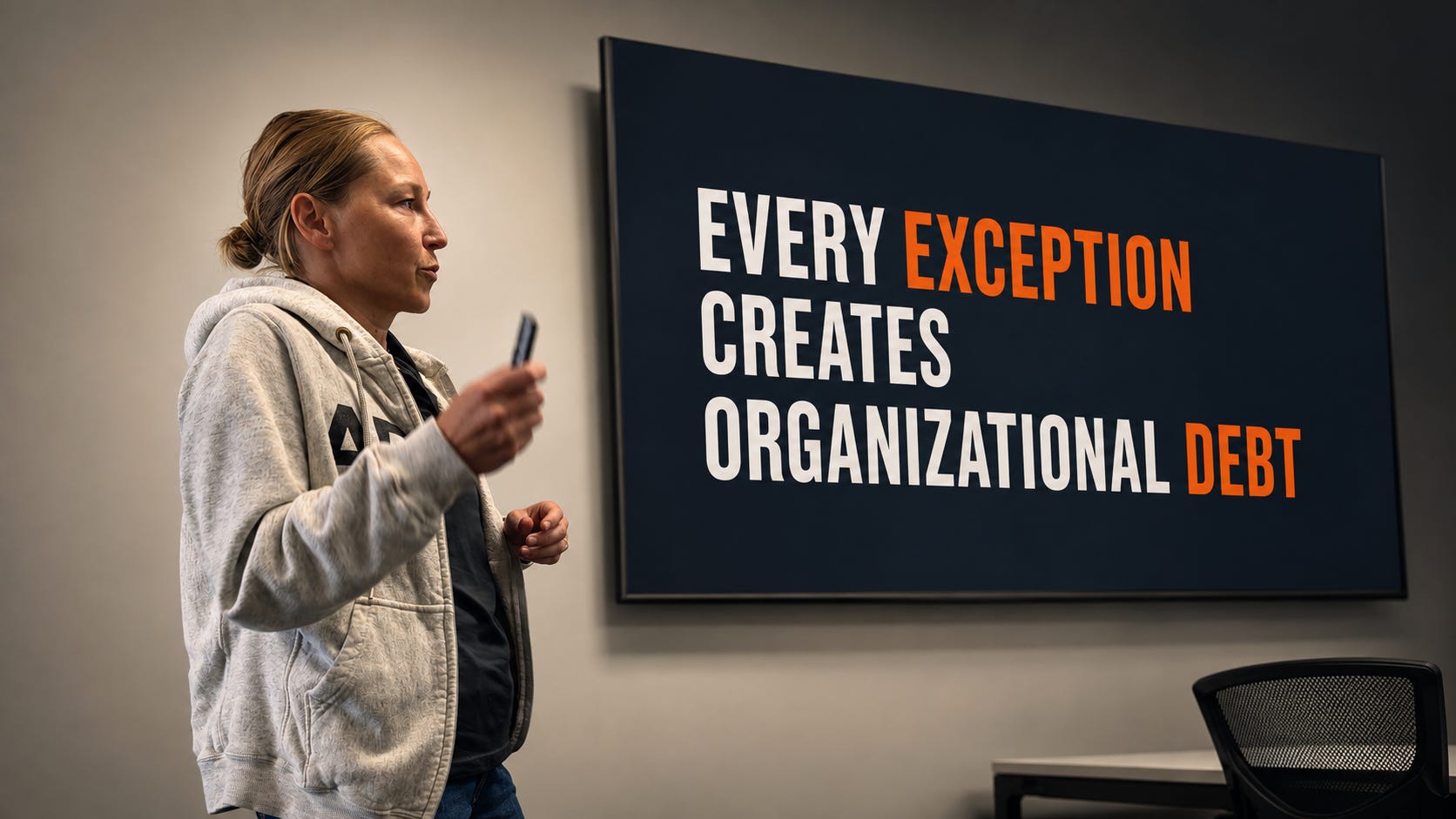
Most exceptions begin with a reasonable sentence.
“Just this once.”
The customer has a special circumstance. The employee is going through a difficult season. The deadline is close. The normal process feels unnecessarily slow. Someone important asks for a favor.
So we make an exception.
Sometimes that is exactly the right decision. Policies exist to support good judgment, not replace it.
But exceptions are rarely free.
Each one creates a cost that may not appear immediately. Someone must remember the different arrangement. A process must be worked around. Another person sees the exception and expects similar treatment. A future leader inherits a decision without understanding why it was made.
The immediate problem disappears.
The debt remains.
The First Exception Is Usually Easy
The first exception often feels harmless because it is small.
We allow a customer to bypass the normal approval process. We support something outside the agreement because the work will take only a few minutes. We let an internal deadline slide because everyone knows the person meant well.
In isolation, none of these decisions may matter very much.
Organizations, however, do not experience decisions in isolation. They experience patterns.
Once a process becomes optional, people stop planning around it. Once a boundary moves, future requests begin from the new boundary. Once a standard is enforced inconsistently, the standard loses authority.
The lesson people learn is not that one unusual circumstance required judgment.
The lesson they often learn is that the rules depend on who asks, who notices, or how much pressure is applied.
That is when flexibility begins turning into dysfunction.
Exceptions Accumulate Like Technical Debt
In technology, technical debt occurs when a quick solution is chosen over a durable one. The shortcut solves today’s problem but makes the system harder to maintain tomorrow.
Organizations accumulate the same kind of debt.
There are undocumented pricing arrangements, unofficial job responsibilities, unsupported equipment, informal promises, custom workflows, and policies that everyone knows are not consistently followed.
Each item may be manageable on its own. Together, they create an organization that is increasingly difficult to understand and operate.
New employees cannot rely on the written process because the real process is a collection of unwritten exceptions. Customers receive different answers depending on whom they ask. Leaders spend their time interpreting history instead of making progress.
Eventually, someone must pay the debt.
They pay it through rework, uncomfortable conversations, lost margin, customer frustration, employee resentment, or operational failure.
The person paying is often not the person who made the original exception.
Inconsistency Damages Trust
People sometimes view consistency as rigid or uncaring.
In reality, consistency is one of the foundations of trust.
Employees want to know that expectations apply fairly. Customers want to understand what is included, what is not, and how decisions will be made. Leaders need confidence that work will follow an agreed process without requiring constant intervention.
When exceptions multiply, people stop trusting the stated standard.
They begin negotiating every decision. They compare their treatment with the treatment of others. They spend energy learning how to work around the system instead of working within it.
A flexible organization adapts when circumstances genuinely require it.
An inconsistent organization changes depending on pressure.
Those are not the same thing.
Make Exceptions Intentionally
The answer is not to eliminate every exception.
Rules cannot anticipate every human circumstance. Mature leadership requires judgment, and judgment occasionally requires departing from the standard.
But an exception should be a conscious decision, not the easiest escape from an uncomfortable conversation.
Before making one, leaders should ask:
Why does this situation truly require different treatment?
Who is authorized to approve the exception?
What precedent might this create?
Who will own the additional work or risk?
Is the exception temporary, and when will it end?
Should the standard itself be changed for everyone?
Documenting the answer matters.
If an exception cannot survive being explained clearly to the next employee, customer, or leader, it probably has not been considered carefully enough.
Today’s Convenience Becomes Tomorrow’s Complexity
Every organization needs room for compassion, discretion, and common sense.
But we should stop pretending that saying yes costs nothing.
Every exception adds a small piece of complexity. Enough small pieces eventually become a system no one fully understands.
Good leadership balances humanity with consistency. It recognizes unusual circumstances without quietly destroying the standards that allow people to work together fairly and effectively.
Sometimes the right decision is to make the exception.
Sometimes the right decision is to hold the line.
The important thing is to understand that either choice creates consequences.
“Just this once” has a way of becoming “this is how we do it.”
Choose carefully. Someone will inherit the decision.