


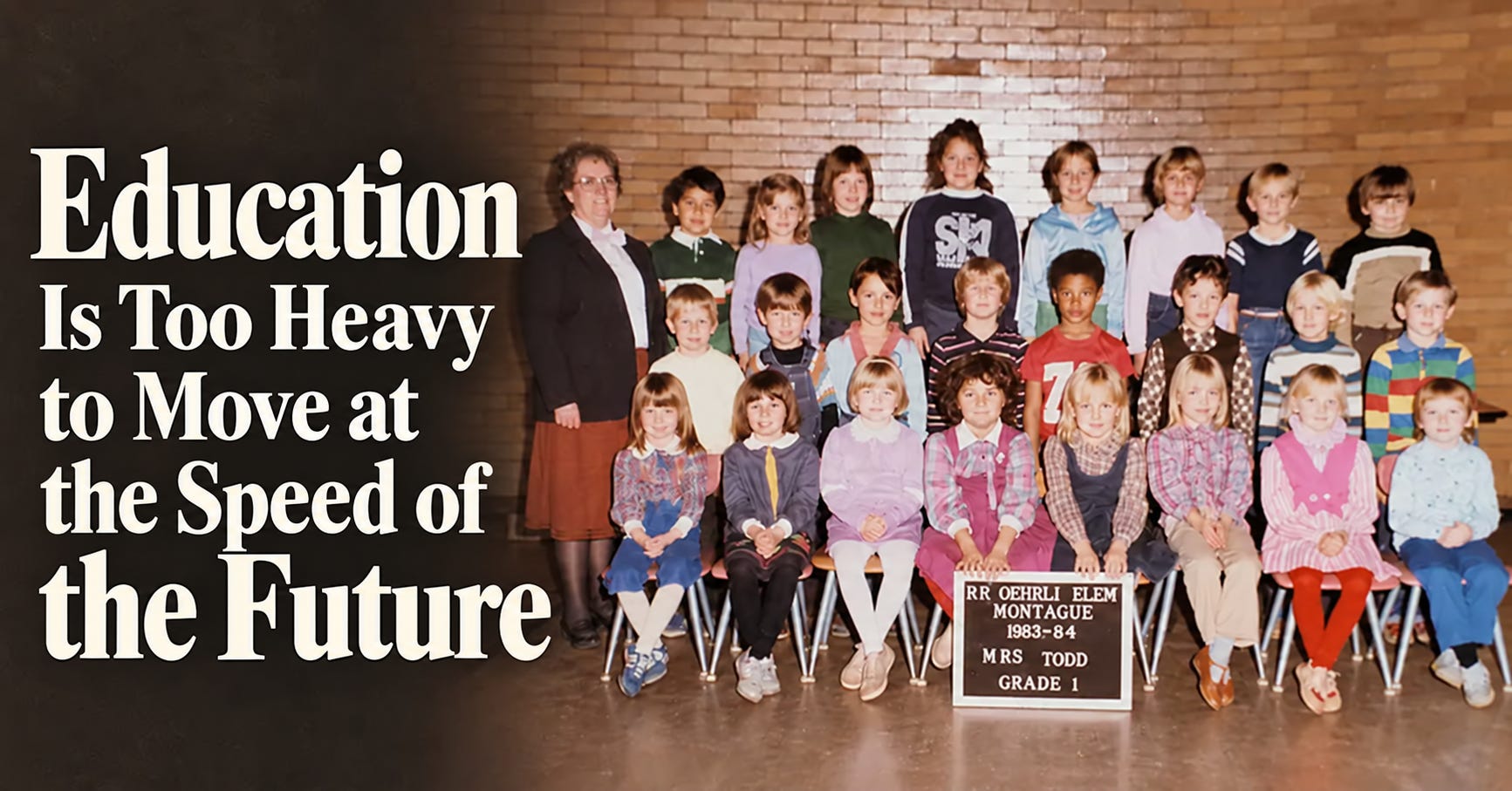
We keep asking education to prepare students for a changing world while expecting it to operate through structures that are difficult to change. We want creativity, adaptability, critical thinking, and initiative. Yet much of the traditional educational experience still revolves around established schedules, separate subjects, standardized assignments, and advancement through a predetermined sequence.
That tension deserves more attention. We can have dedicated teachers, capable administrators, and supportive communities and still have a system whose structure makes meaningful adaptation painfully slow.
As someone who works in technology and serves in public education, I see this challenge from two directions. Businesses need people who can learn, exercise judgment, and solve unfamiliar problems. Schools must prepare those people while navigating responsibilities and constraints that employers rarely have to consider.
My concern is that the distance between those two worlds will continue to grow unless we change how education itself changes.
The weight of the system
Traditional education carries an enormous amount of institutional weight. Curriculum, funding, staffing, schedules, assessments, graduation requirements, and public expectations are connected. Changing one part can require changes across several others.
Even a reasonable proposal can raise difficult questions. Who will teach it? What will it replace? How will learning be measured? Will every student have access? How does it fit existing requirements?
Those questions matter. Schools serve children with different needs, and public institutions must be accountable. But when every adjustment requires navigating the entire structure, adaptation becomes an extraordinary effort rather than a normal function.
The OECD has examined this challenge through the concept of curriculum time lag: the delays between recognizing a need, deciding on a response, implementing it, and seeing its effects in student learning. A system can identify the right problem and still respond too slowly. (OECD curriculum analysis)
Meanwhile, students continue moving through it. They do not get those years back.
Adding more will not solve it
Education often responds to new demands by adding something. Add a technology course. Add financial literacy. Add career exploration. Add another assessment or reporting requirement.
Each addition may have value. Together, they can create a crowded system in which teachers are responsible for more without receiving more time or room to make decisions.
We cannot keep expanding the list of expectations without examining what should be removed, combined, or redesigned. Meaningful change requires the willingness to stop doing some things, including things that once served us well.
That is difficult because familiar practices develop defenders. A schedule becomes tradition. A requirement becomes evidence of rigor. A program becomes part of an institution’s identity. Eventually, questioning the practice can feel like questioning the people who built it.
Leadership requires making that distinction. Respecting past work does not obligate us to preserve it forever.
What students need to carry forward
Strong foundations remain essential. Students need to read carefully, write clearly, understand mathematics, evaluate evidence, and develop knowledge of the world. Critical thinking needs something to think about.
The challenge is helping students use those foundations beyond the conditions of a classroom assignment.
Can they identify a problem when nobody has written it at the top of a worksheet? Can they recognize missing information, ask useful questions, and explain their reasoning? Can they work through disagreement, accept correction, and revise an approach that is failing?
Artificial intelligence makes these questions especially relevant. When a tool can produce a polished response, the response alone tells us less about what a student understands. Students need opportunities to defend their conclusions, examine sources, demonstrate their process, and recognize when a convincing answer is wrong.
Buying new technology will not accomplish that by itself. A digital worksheet can preserve exactly the same assumptions as a paper one. Meaningful modernization changes what students are asked to do and what counts as evidence of learning.
Build the capacity to adapt
A more responsive educational system would create room for teachers to test approaches, examine results, and make improvements without turning every experiment into a permanent commitment.
It would connect academic learning to practical problems. A community project could require research, mathematics, writing, collaboration, and a public explanation of the result. Students would experience how knowledge works together while teachers retain clear expectations for the skills being developed.
It would also recognize multiple credible paths into adulthood. College, skilled trades, apprenticeships, military service, entrepreneurship, and direct employment deserve thoughtful preparation. Students need guidance that connects their abilities and interests to real opportunities.
These changes require time, support, and accountability. Teachers cannot be expected to redesign learning while carrying every existing obligation unchanged. Communities cannot demand innovation and then treat every thoughtful departure from tradition as a decline in standards.
We also need safeguards so that flexibility benefits students who need additional support, rather than becoming another advantage available primarily to those who already have it.
The responsibility to move
I do not believe education is incapable of changing. I believe we have made change unnecessarily difficult, and we too often expect individual educators to overcome structural problems through personal effort.
The future will remain uncertain. We cannot design a curriculum around every tool or career that might emerge. We can build an institution that reviews its assumptions, responds to evidence, and makes room for better approaches.
That is the responsibility in front of us: to preserve the foundations students need while reducing the weight that prevents education from moving.
We ask students to keep learning, reconsider their assumptions, and adapt when circumstances change. The system preparing them should be willing and able to do the same.