


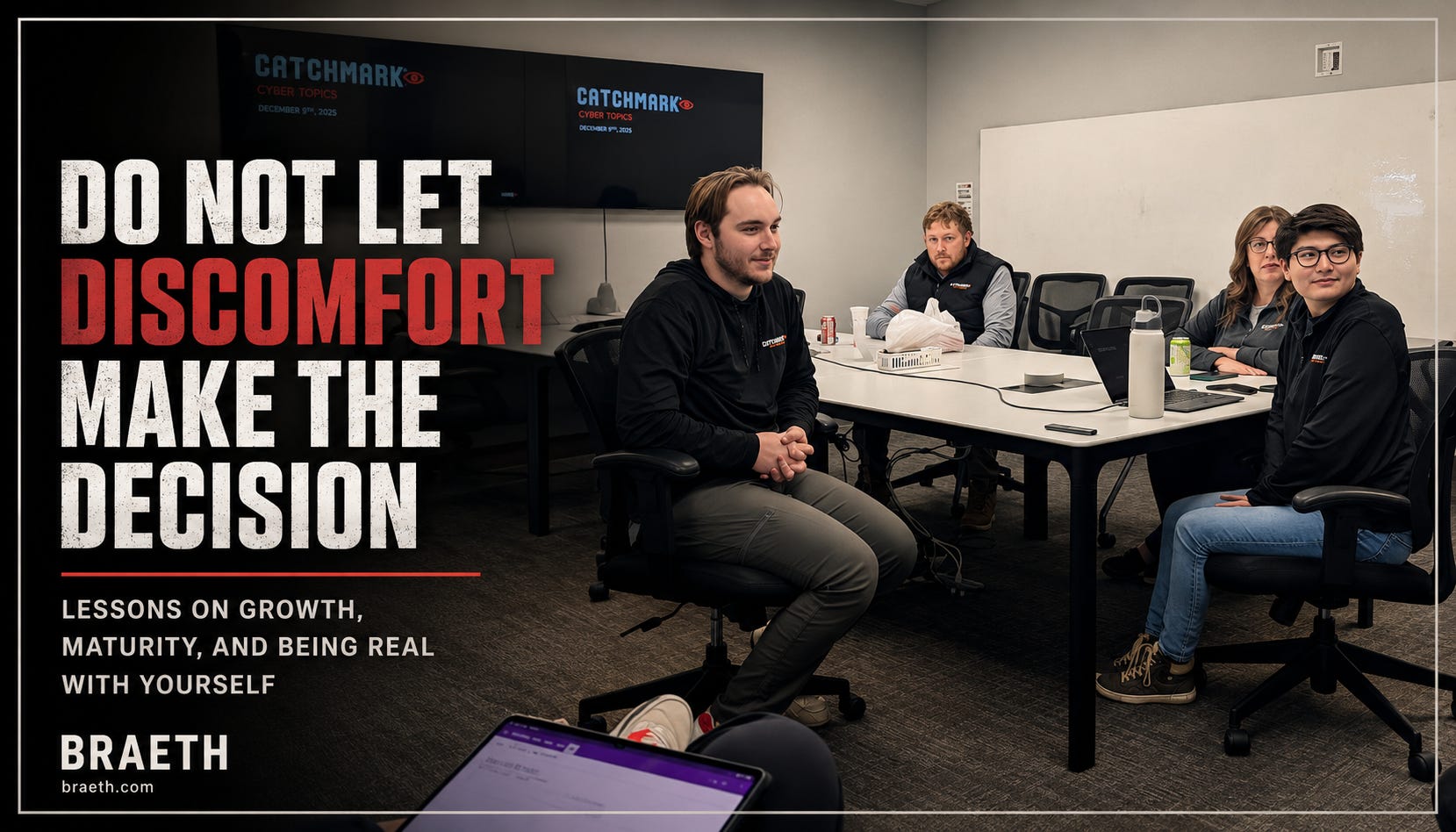
My son Conner has worked for CatchMark Technologies for almost five years.
He started as an intern while attending the networking program at the MAISD Career Tech Center.
And before going any further, their programs deserve recognition. They give students the opportunity to develop practical skills, explore potential careers, and enter the workforce with meaningful experience. Conner’s time there gave him a strong foundation and created an opportunity that may not have existed through a more traditional educational path.
After graduating from high school, he joined CatchMark full time as a Level 1 technician.
Since then, he has continued to learn, take on more responsibility, and grow within the organization.
It has not always been sunshine and rainbows.
Working for a family business is complicated.
Working for your father is probably even more complicated.
There are moments when the lines between parent, leader, employee, mentor, and son become difficult to separate. There have been disagreements, frustrations, hard conversations, and times when both of us probably wished the situation were a little easier.
But easy has never been the goal.
Growth has been the goal.
Potential Comes With Complications
Conner is incredibly bright.
He has an innate sense of logic that makes him a naturally gifted troubleshooter. He can look at a problem, process the pieces, and often see connections that other people miss.
He is also wildly curious.
He wants to understand how things work, why decisions were made, and whether there might be a better way to accomplish something.
Those qualities can make someone extremely valuable in technology.
They can also create challenges.
Conner has always carried a level of confidence that sometimes arrives ahead of his experience. At its best, that confidence allows him to attempt things other people might avoid. It pushes him to experiment, ask questions, and take on difficult problems.
At its worst, it can become reckless.
It can make him believe he understands something before he has taken the time to fully understand it. It can cause him to underestimate risk, dismiss established processes, or resist guidance that experience has proven valuable.
The same characteristic can be both a strength and a weakness.
That is true for most of us.
Our greatest strengths, when left unmanaged, often become our greatest liabilities.
Confidence without humility becomes arrogance.
Curiosity without discipline becomes distraction.
Independence without accountability becomes isolation.
Potential is valuable, but potential still has to be developed.
When the Career Question Appears
Over the past year, Conner has questioned whether technology is the career field he wants to remain in long term.
That is a reasonable question.
He began working in technology at a young age. He did not have years to explore different industries, attend college, change majors, or try several unrelated jobs before beginning his career.
He entered the workforce and started building immediately.
I do not believe someone should remain in a career simply because it was the first opportunity available to them. People change. Interests evolve. New abilities emerge. Sometimes the work that fits us at eighteen no longer fits us at twenty-five or forty-five.
Recently, Conner was offered a position with a wonderful local business.
It was a legitimate opportunity with significant potential.
More importantly, someone outside of our organization saw something in him. They saw his intelligence, personality, work ethic, and potential, and they were willing to invest in him.
As his father, that made me proud.
It is one thing for your parents to believe in you.
It is meaningful when someone who does not owe you anything sees the same potential.
I encouraged him to seriously consider the position.
I did not tell him he had to remain at CatchMark. I did not want him to stay simply because I am his father, because the company is familiar, or because leaving would create an inconvenience for us.
There may come a time when another opportunity is the right decision for him.
But I encouraged him to make sure he was considering this opportunity for the right reasons.
That became the more difficult conversation.
Opportunity or Escape?
As we talked, something began to become clear.
The decision was not entirely about discovering a new calling.
At least part of it was about escaping the expectations, growth, and pressure that come with maturing inside an organization.
Conner is no longer the high school intern.
He is no longer the new technician who receives unlimited patience because everything is unfamiliar.
As his experience has grown, the expectations have grown with it.
He is expected to communicate better.
He is expected to make more responsible decisions.
He is expected to recognize risk.
He is expected to follow through consistently.
He is expected to help others, accept accountability, and produce excellent work even when the task is not interesting or enjoyable.
That is what maturity looks like inside an organization.
The reward for demonstrating potential is usually more responsibility.
The reward for becoming capable is that people begin expecting more from you.
That pressure can feel unfair when you are experiencing it, but it is often evidence that people believe you are capable of carrying more.
The new opportunity was real.
But so was the temptation to view it as an easier path away from a team with high standards and an expectation of consistent excellence.
That distinction mattered.
Not because the other business lacked standards.
Not because the opportunity was somehow less valuable.
And not because changing careers is wrong.
It mattered because motives travel with us.
You Take Yourself With You
Changing jobs can change your environment.
It can change your manager, coworkers, responsibilities, schedule, and compensation.
But it does not automatically change you.
You take your habits with you.
You take your insecurities with you.
You take your strengths, weaknesses, discipline, attitude, and unresolved patterns with you.
A new environment may temporarily remove pressure, but maturity eventually creates expectations everywhere.
If you leave every time the standard rises, you may begin a pattern that becomes increasingly difficult to break.
The first time, you tell yourself the company was the problem.
The next time, it was the manager.
Then it was the culture, the workload, the coworkers, the expectations, or the lack of appreciation.
Sometimes those things truly are the problem.
Bad organizations exist.
Poor leaders exist.
Toxic environments exist.
There are absolutely times when leaving is the healthy and responsible decision.
But sometimes the discomfort is not proof that we are in the wrong place.
Sometimes it is proof that we are being asked to grow.
If we never stop long enough to honestly examine the difference, we can spend our lives running from the exact pressure that would have helped us become better.
The Hardest Person to Be Honest With
Ultimately, Conner decided to stay at CatchMark.
I am glad he stayed, but that is not what made me most proud.
I would have supported him if, after honestly examining the opportunity and his motives, he had decided it was the right path.
What made me proud was his willingness to look at himself honestly.
That is difficult for anyone.
It is especially difficult when the person asking the questions is your father and your employer.
It would have been easier to become defensive.
It would have been easier to dismiss the feedback as an attempt to keep him from leaving.
It would have been easier to focus only on what CatchMark, the team, or I could have done differently.
Instead, he was willing to ask a harder question:
Am I moving toward something meaningful, or am I simply running away from something uncomfortable?
That question requires courage.
Real self-reflection is not the ability to list our strengths or explain our intentions.
It is the willingness to consider that our own story about ourselves may be incomplete.
It is being able to admit that a decision we have justified as opportunity may also contain fear.
It is recognizing that the people challenging us may not be trying to hold us back. They may be trying to prevent us from carrying an unhealthy pattern into the next chapter of our lives.
Do Not Stay for the Wrong Reasons Either
There is another side to this lesson.
Just as we should not leave for the wrong reasons, we should not stay for the wrong reasons.
Conner should not remain at CatchMark forever because he is afraid to disappoint me.
He should not build a career he does not want because it is convenient for the company.
He should not confuse loyalty with obligation or familiarity with purpose.
Someday, another opportunity may be exactly right.
He may discover a different field that better uses his abilities.
He may decide that technology is not where he wants to invest the next several decades of his life.
When that day comes, I hope he moves toward it confidently.
But I also hope he makes the decision from a place of clarity rather than escape.
Do not let temporary frustration make a permanent decision for you.
Do not let pressure convince you that you are in the wrong place before considering whether the pressure is producing necessary growth.
Do not mistake accountability for mistreatment.
And do not assume the easier path is automatically the better one.
What Made Me Proud
I am proud of the technician Conner has become.
I am proud that another respected local business saw his potential.
I am proud of the husband, father, teammate, and man he continues to become.
But in this moment, I am most proud that he was willing to be real with himself.
He did not make the comfortable decision immediately.
He wrestled with it.
He listened.
He reflected.
He separated the opportunity from the motive.
That does not mean every question has been answered.
It does not mean there will not be more struggles, frustration, or difficult conversations.
There will be.
That is part of growth.
But learning to examine our own motives may be one of the most important skills any of us can develop.
Because the easiest person to deceive is often ourselves.
And one of the clearest signs of maturity is the willingness to stop running long enough to ask whether the thing we are trying to escape might actually be the thing helping us grow.