


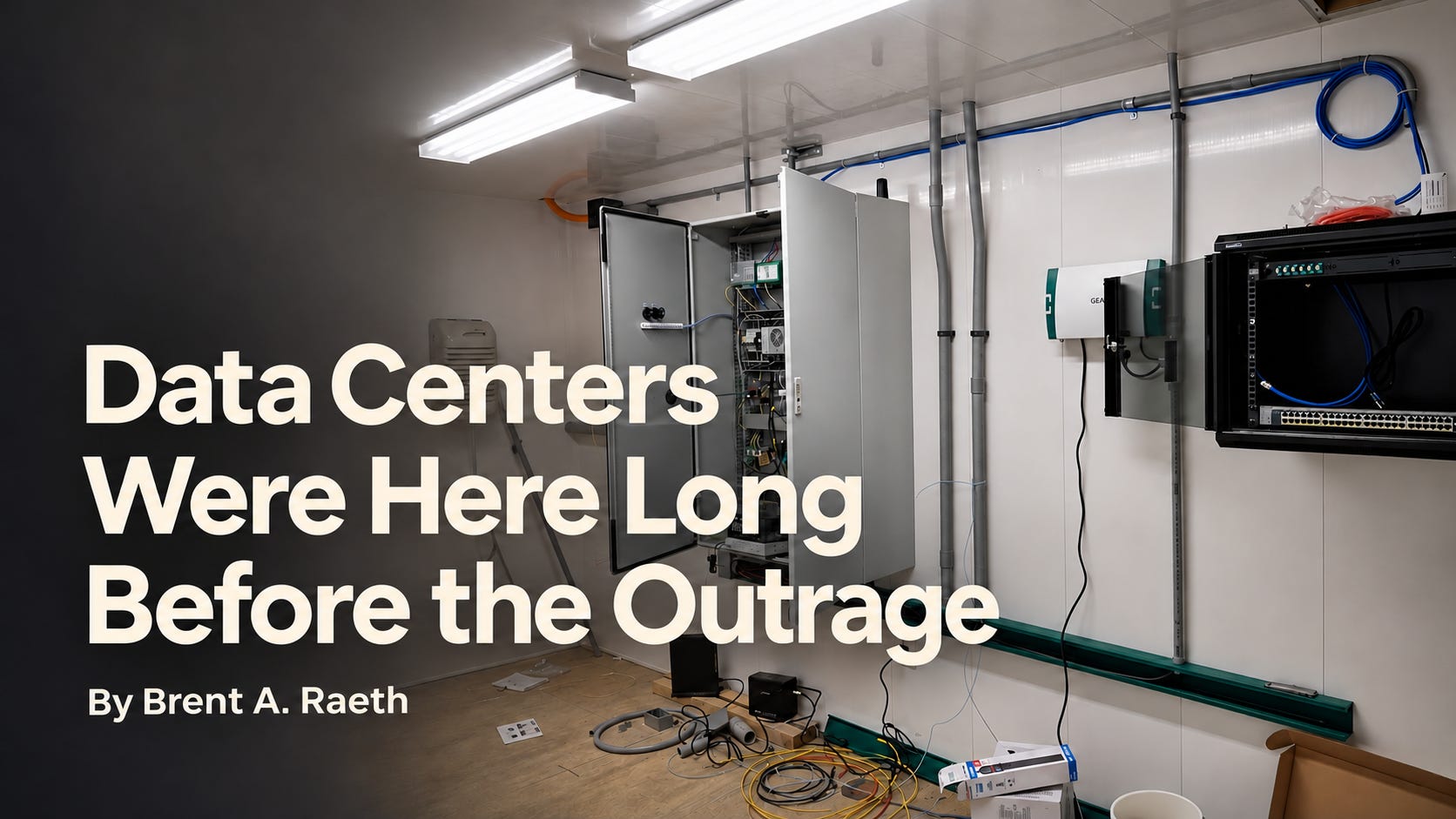
If you want to talk about data centers in West Michigan, start with the pyramid.
In March 2017, Switch opened a data center in the former Steelcase Pyramid in Gaines Township, just outside Grand Rapids. For nearly a decade, people here have been able to point to an actual data center in one of the most recognizable buildings in the region. I’d be curious how many people who have strong opinions about data centers today knew what was inside it a year ago.
I run a technology company. When a business owner asks me about backups, what they usually want to know is whether they can get their files back and how soon their people can get back to work. Fair questions. Rarely does anybody ask what the building looks like at the other end of that service. We’ve spent years calling it “the cloud,” which made it awfully easy to forget there was a building at all.
Now the building is the story. Some of that attention is overdue. Some of it, I suspect, comes from a habit we ought to recognize in ourselves by now. A subject shows up in our feed often enough, we pick up the language of the argument, and within a week we’re talking as though we’ve followed the issue for years.
Before we decide what to be angry about, it’s worth knowing what actually happened.
We had hundreds before most of us had broadband
In the early 1960s, IBM and American Airlines built Sabre, a centralized computer reservation system. An airline agent could use a terminal to check seat availability against a shared inventory. Think about the ordinary problem that solved. Two agents in different cities needed to know whether they were selling the same seat. That required a computer somewhere that both of them could reach. The same basic idea would become familiar to anyone who has checked a bank balance, booked a hotel room, or bought the last ticket to a ballgame online.
By 1998, the federal government alone reported 432 data centers. In 2009, the reported count was 1,100. By July 2010, it was 2,094. Those figures come from the U.S. Government Accountability Office. They describe a federal inventory, which leaves out the private facilities banks, airlines, retailers, and technology companies used. The government also changed its counting rules over time, so a jump in the inventory cannot tell us how many buildings went up that year. What the record establishes is straightforward. We had hundreds decades ago, and thousands within the federal inventory alone more than fifteen years ago.
For a more recent picture, Pew Research Center analyzed a national industry directory and found more than 3,000 operating U.S. data centers as of February 2026, with at least 1,500 more listed in various stages of development. Virginia alone had 398 operating facilities. The development figure includes land set aside for possible projects, so it would be a mistake to tell people that all 1,500 are under construction. It would also be a mistake to line up Pew’s directory with the old federal inventory and treat them as a single growth chart. They count different things.
What actually changed
If I told you the algorithm was the only reason people care today, I’d be asking you to ignore some pretty important numbers.
In 2007, the Environmental Protection Agency reported to Congress that U.S. servers and data centers had used an estimated 61 billion kilowatt-hours of electricity in 2006, about 1.5% of all electricity consumed in the country. Congress was asking about the electric bill almost twenty years ago.
The more recent change is the pace. Lawrence Berkeley National Laboratory estimated that U.S. data center electricity use rose from 76 billion kilowatt-hours in 2018 to 176 billion in 2023. In five years, the industry’s share of national electricity consumption went from 1.9% to 4.4%. Growing demand for computing, including the specialized servers used for artificial intelligence, helped drive that increase. A township trustee looking at a large project today has good reason to ask harder questions about power than someone might have asked ten years ago.
The geography changed, too. Pew found that 87% of operating facilities were in urban areas, while roughly two-thirds of planned facilities were in rural areas. For somebody who lives across the road from a proposed site, this may genuinely be the first time a data center has mattered to them. A national industry can be decades old and still be new business for a township planning commission.
What the algorithm adds
Here’s where I think the outrage argument holds up. In January 2026, 30% of Americans told Pew they thought data centers were mostly bad for the quality of life of people living nearby. By August, 49% said so. In that summer survey, people who lived near a data center and people who didn’t had similar views. That’s a substantial shift in seven months. The survey tells us opinions changed. It cannot tell us which posts people saw or why any individual changed their mind.
We do know something about how outrage travels. Yale researchers examined 12.7 million tweets and conducted controlled experiments. They found that when people received positive feedback for expressing moral outrage, they became more likely to express it again. The researchers studied online behavior generally. They didn’t study a Michigan data center fight. But the incentive they documented ought to sound familiar to anybody who has ever watched a local Facebook discussion unfold.
Imagine two posts about the same township meeting. One says, “I read the application. I still can’t tell who pays for the substation if the developer walks away.” The other says, “They’re sticking you with the electric bill.”
Which one would you share? More importantly, would you open the application before you did?
The first person has identified a question the township can put to the developer. By the time the second post gets shared fifty times, somebody at the next meeting may have to spend half the evening establishing whether the claim was ever true. And the resident who asked the good question may go home without an answer.
That’s what bothers me. A developer can hand the public a brochure full of promises and reasonably expect somebody to ask for evidence. A stranger can make an equally sweeping claim in the opposite direction, and we’ll pass it along to people who trust us because it sounds like something a developer might do. Why should the stranger get a lower standard of proof?
What I’d want answered at the township meeting
I’d start with the electric bill. Who pays for the new lines and substation? If the company reserves capacity and then scales back or leaves, who owes the balance? I’d want to see where the agreement assigns that cost.
Then I’d ask about water. What cooling system will this particular facility use? How much water will it draw on the hottest day of the year, where will that water come from, and how much will be returned? A national average is little comfort to the person responsible for keeping a local water system running in August.
I’d give the sales pitch the same scrutiny. If a developer promises jobs, how many people will still work there two years after construction ends? If the pitch includes tax revenue, how much will the community actually receive after incentives, and when does the first payment arrive? If the nearest homeowner hears cooling equipment through a bedroom window at two in the morning, who measures the noise and who has authority to do something about it?
Those questions leave room for an honest yes or an honest no. Some projects deserve to be rejected. A developer who wants a community’s approval owes that community enough information to make the decision. And those of us asking our neighbors to oppose a project owe them the courtesy of reading the same material.
The next time a data center story lands in my feed, I want to ask myself one question before I share it. If somebody showed up at the township meeting because they trusted my name above that post, could I show them where the claim came from?
If I can, I’ll bring the document and point to the page. If I can’t, I’ve got some reading to do.