


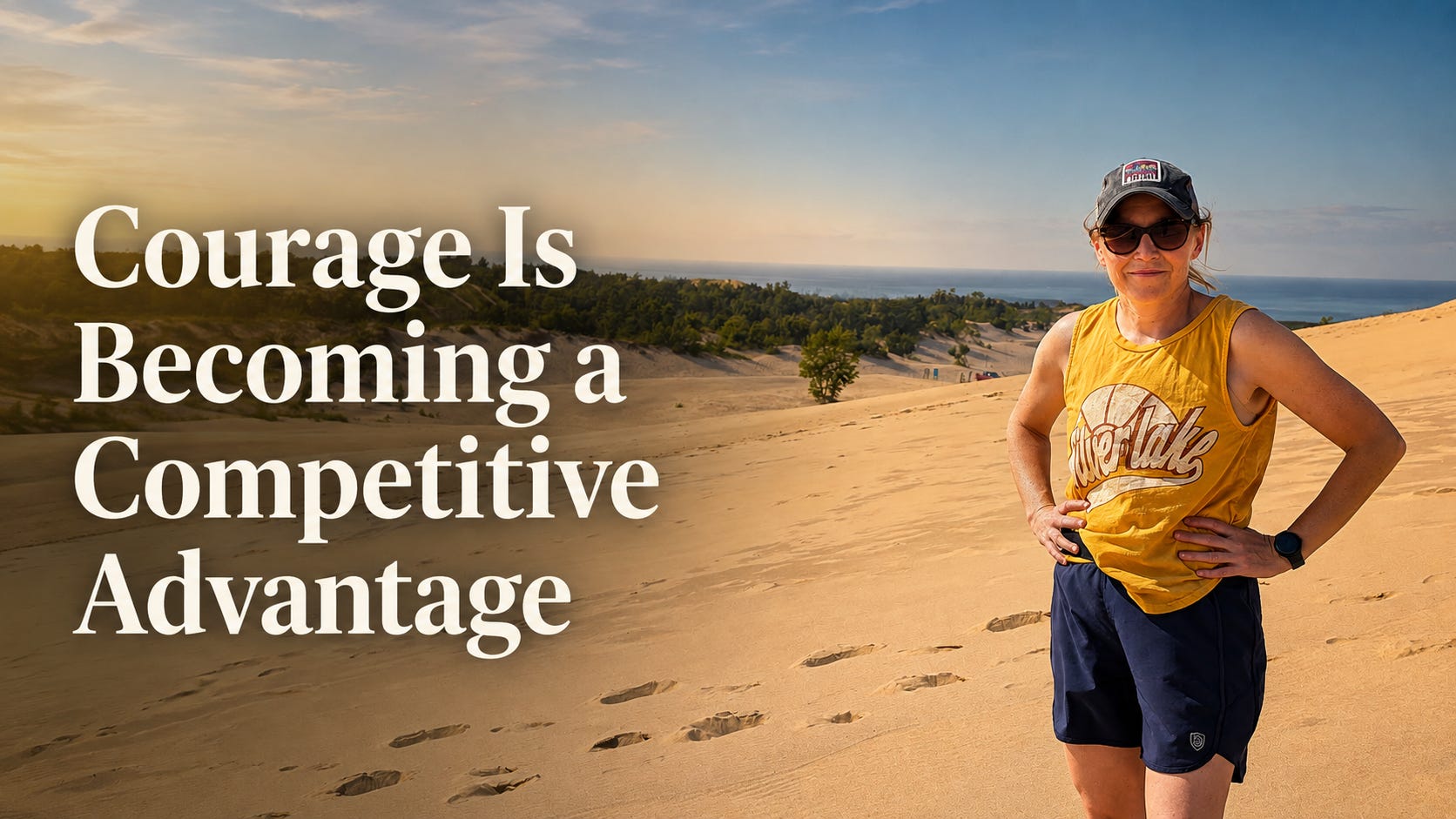
Kara and I spent the evening at the Silver Lake Sand Dunes recently.
We parked at the state park and walked up and across the dunes all the way to Lake Michigan. By the time we made the trip there and back, we had covered about 2.4 miles.
Walking through sand for that distance is not easy.
There were steep climbs, loose footing, tired legs, and plenty of moments when the next dune looked taller than the last one. But eventually we made it to the lake.
We stood there looking out over Lake Michigan as the sun dropped toward the horizon.
And I had a thought.
What would it have been like to stand at the edge of what you knew, get into a boat, and leave without really knowing what was on the other side?
No satellite imagery.
No GPS.
No weather app.
No map showing you exactly where you were going.
No guarantee that you would find what you hoped to find.
Maybe no guarantee that you would ever come home.
I thought about the early explorers who crossed oceans into largely unknown territory. I thought about Lewis and Clark leaving St. Louis and heading west across a continent that, from their perspective, contained enormous stretches of uncertainty.
The amount of courage and self confidence required to do something like that is almost difficult to comprehend today.
They did not know exactly what they would encounter.
They knew there would be danger.
They knew there would be hardship.
They knew they could fail.
And they went anyway.
Standing on the shore of Lake Michigan, I found myself wondering whether we are slowly losing some of that spirit.
Not because we need everyone to become an explorer or cross an ocean into the unknown.
But because that willingness to face uncertainty, hardship, risk, and discomfort seems to be disappearing from everyday life.
We have built so much fear into the way we live and work that simply being willing to face something difficult is starting to look extraordinary.
I have been thinking a lot about courage lately.
Not the dramatic kind.
I mean ordinary courage.
The courage to make a decision when you do not have every answer.
The courage to tell someone the truth when you know they may not want to hear it.
The courage to try something that might fail.
The courage to take responsibility when the outcome is uncertain.
The courage to have the conversation everyone else keeps avoiding.
The courage to say, “I do not know, but I will figure it out.”
I am increasingly convinced that this kind of courage is disappearing from our workplaces and teams.
I think part of the reason is that, as a society, we have woven fear into almost everything we do.
We Have Become Obsessed With Avoiding Risk
Somewhere along the way, we began treating risk as though it were always a problem to be eliminated.
We created policies to protect ourselves. Processes to protect ourselves. Committees to protect ourselves. Layers of approval to protect ourselves. Documentation to protect ourselves. Rules designed not necessarily to produce the best outcome, but to make sure nobody can be blamed if the outcome is bad.
Some of those things are necessary.
Good process matters.
Thoughtful risk management matters.
Accountability matters.
But there is a point where risk management becomes fear management, and fear management eventually becomes paralysis.
You can see it everywhere.
People wait for permission.
They ask for another meeting.
They copy more people on the email.
They avoid making a recommendation.
They push decisions upward.
They identify problems without taking ownership of solving them.
Sometimes we spend more time making sure we cannot be blamed for a problem than we spend actually fixing the problem.
We have become exceptionally skilled at protecting ourselves from failure.
Unfortunately, we have also become pretty good at protecting ourselves from progress.
Hard Problems Require People Willing to Be Uncomfortable
Hard problems do not come with certainty.
If the biggest problems inside an organization were easy, someone probably would have solved them already.
Hard problems are messy.
The information is incomplete.
There are competing priorities.
Somebody is going to disagree.
There may not be a perfect answer.
You may make the wrong decision.
You may disappoint someone.
You may have to change direction later.
That is exactly why courage matters.
Solving difficult problems requires a willingness to operate without certainty.
It requires people who can look at an uncomfortable situation and move toward it instead of away from it.
That does not mean being reckless.
Courage and recklessness are very different things.
Recklessness ignores consequences.
Courage understands the consequences and acts anyway because doing nothing has consequences too.
The explorers I thought about while standing on the shore of Lake Michigan were not courageous because they believed nothing bad could happen.
They were courageous because they knew something bad could happen and still believed the journey was worth taking.
That distinction matters.
Fear Disguises Itself as Responsibility
One of the most dangerous things about fear in the workplace is that it rarely sounds like fear.
It sounds responsible.
“We should probably get a little more information.”
“Maybe we should wait.”
“I just want to make sure everyone is comfortable.”
“We should probably run this past a few more people.”
“What if this does not work?”
“Has anyone else done this before?”
None of those questions are inherently wrong.
Sometimes waiting is wise.
Sometimes more information is necessary.
Sometimes collaboration absolutely improves a decision.
But we should be willing to ask ourselves a harder question.
Are we being thoughtful, or are we afraid?
Those two things can look remarkably similar from the outside.
One leads to better decisions.
The other gives us increasingly sophisticated excuses for avoiding them.
We Are Teaching People That Discomfort Means Danger
I think this problem extends far beyond the workplace.
We have increasingly built a culture that treats discomfort as something that should be eliminated.
Difficult feedback feels harmful.
Disagreement feels personal.
Failure feels unacceptable.
Stress feels like evidence that something has gone wrong.
Uncertainty feels irresponsible.
Yet much of human growth happens inside those experiences.
You cannot become resilient without experiencing difficulty.
You cannot become confident without doing things before you feel confident.
You cannot become a good decision maker without making decisions.
You cannot become comfortable with conflict by avoiding conflict.
You cannot learn how to recover from failure if failure is never permitted.
We seem to want resilient people while systematically removing many of the circumstances that create resilience.
That does not work.
There is something almost ironic about standing on top of a sand dune after a difficult climb.
The view feels better because the walk was hard.
The sunset was not more beautiful because we had worked to get there, but our experience of it certainly was.
The difficulty was not something separate from the experience.
It was part of the experience.
I think we forget that sometimes.
Courage Is a Muscle
Courage is not something you either have or you do not have.
I believe it is something you practice.
Every time you speak when remaining silent would be easier, you strengthen it.
Every time you accept responsibility for a difficult decision, you strengthen it.
Every time you attempt something without knowing exactly how it will turn out, you strengthen it.
Every time you receive criticism without immediately becoming defensive, you strengthen it.
Every time you admit you were wrong and change course, you strengthen it.
Every time you walk directly toward a difficult problem instead of hoping someone else handles it, you strengthen it.
The opposite is true too.
Every time fear makes the decision for you, fear becomes a little easier the next time.
Avoid enough difficult conversations and eventually every conversation feels difficult.
Avoid enough decisions and eventually every decision feels dangerous.
Avoid enough risk and eventually anything uncertain begins to feel irresponsible.
That is how organizations become timid.
Not all at once.
One avoided decision at a time.
Leaders Have to Make Courage Safe
Leaders have an enormous responsibility in this.
You cannot tell people to take initiative and then punish every imperfect outcome.
You cannot ask people to make decisions and then criticize them because they did not make the exact decision you would have made.
You cannot say you want innovation while demanding certainty before anything new is attempted.
People pay attention to what actually gets rewarded and what actually gets punished.
If thoughtful failure is punished more severely than passive inaction, people will quickly learn that doing nothing is safer.
That may protect careers.
It will not build great organizations.
The goal should never be to encourage careless failure.
The goal should be to create an environment where people can make thoughtful decisions, own the outcomes, learn from mistakes, and adjust.
I would much rather work with someone who makes a reasonable decision, gets it wrong, takes responsibility, learns from it, and becomes better than someone who spends three weeks avoiding the decision because they are terrified of being wrong.
One person is growing.
The other is hiding.
The Courage to Tell the Truth
There is another form of courage that may be even more important in our organizations.
The courage to tell the truth.
Organizations become dysfunctional when people stop saying what they actually think.
Someone knows the project is failing but says nothing.
Someone knows a teammate is struggling but avoids the conversation.
Someone knows a strategy is flawed but nods along in the meeting.
Someone disagrees with the leader but waits until the leader leaves the room before saying it.
Someone sees a problem developing but decides it would be safer not to get involved.
That silence is expensive.
Healthy teams need people willing to respectfully say, “I think we are wrong.”
They need someone willing to say, “I do not think this is working.”
“I made a mistake.”
“I need help.”
“We are avoiding the real issue.”
“That is not good enough.”
“We need to have a difficult conversation.”
Those sentences require courage.
They also solve problems.
Courage Is Not the Absence of Fear
I do not believe courageous people are fearless.
Most courageous people I know feel plenty of fear.
They simply refuse to let fear make every decision.
They feel nervous and speak anyway.
They feel uncertain and decide anyway.
They know they might fail and try anyway.
They know the conversation will be uncomfortable and have it anyway.
That is courage.
Fear asks, “What happens if this goes wrong?”
Courage asks that question too.
Then it asks another one.
“What happens if nobody does anything?”
That second question changes everything.
Because inaction is still a decision.
Avoidance still has consequences.
Silence still produces outcomes.
Doing nothing is not neutral.
We Need More People Willing to Go First
The world does not need more people pointing at difficult problems.
We have plenty of those.
We need people willing to move toward them.
People willing to ask the uncomfortable question.
People willing to make the first attempt.
People willing to own the decision.
People willing to be wrong publicly.
People willing to challenge conventional thinking.
People willing to say what needs to be said.
People willing to endure a little discomfort in pursuit of something better.
We need some of the spirit that caused people throughout history to look at the edge of what was known and wonder what might be beyond it.
Not because every risk is worth taking.
Not because every unknown should be explored.
But because progress has always required someone willing to go first.
That kind of courage has always mattered, but in a culture increasingly designed around safety, certainty, comfort, and blame avoidance, I believe it is becoming rare.
And anything valuable that becomes rare eventually becomes an advantage.
The courageous teammate will solve problems others avoid.
The courageous leader will make decisions others postpone.
The courageous organization will try things competitors are too afraid to attempt.
The courageous person will grow while everyone else waits to feel ready.
We are never going to remove fear from work, and I am not sure we should.
Fear tells us that something matters.
But fear cannot be allowed to become the architect of everything we build.
Some things are supposed to be difficult.
Some conversations are supposed to be uncomfortable.
Some decisions are supposed to carry risk.
Some problems are supposed to test us.
Our job is not to build a life or a workplace where nothing is hard.
Our job is to become the kind of people who can handle hard things.
To stand at the edge of what we know, look toward what we do not, and have enough courage to take the next step anyway.
That requires courage.