


We lost a customer the other day.
That is never fun to write, and it is certainly not fun to experience. In business, you work hard to serve well, build trust, and create value. When a client decides to move on, even if it makes sense on paper, it still stings.
What made this one more frustrating was that the transition was a bit clunky. Communication was not as clean as it could have been. Expectations were not always aligned. There were tense emails. A few pointed comments. Some second guessing. Ego flared. Tension rose.
Everyone had an opinion about what the other person or organization did wrong.
And if I am honest, I got caught up in it too.
I found myself replaying conversations in my head. Thinking about what they should have done differently. What they could have handled better. Where they dropped the ball. I felt the internal pull to correct, to defend, to control the narrative and the outcome.
But there was a problem.
I was trying to control things that were never mine to control.
I cannot control another organization’s decisions.
I cannot control someone else’s tone.
I cannot control how another leader interprets events.
I cannot control the past.
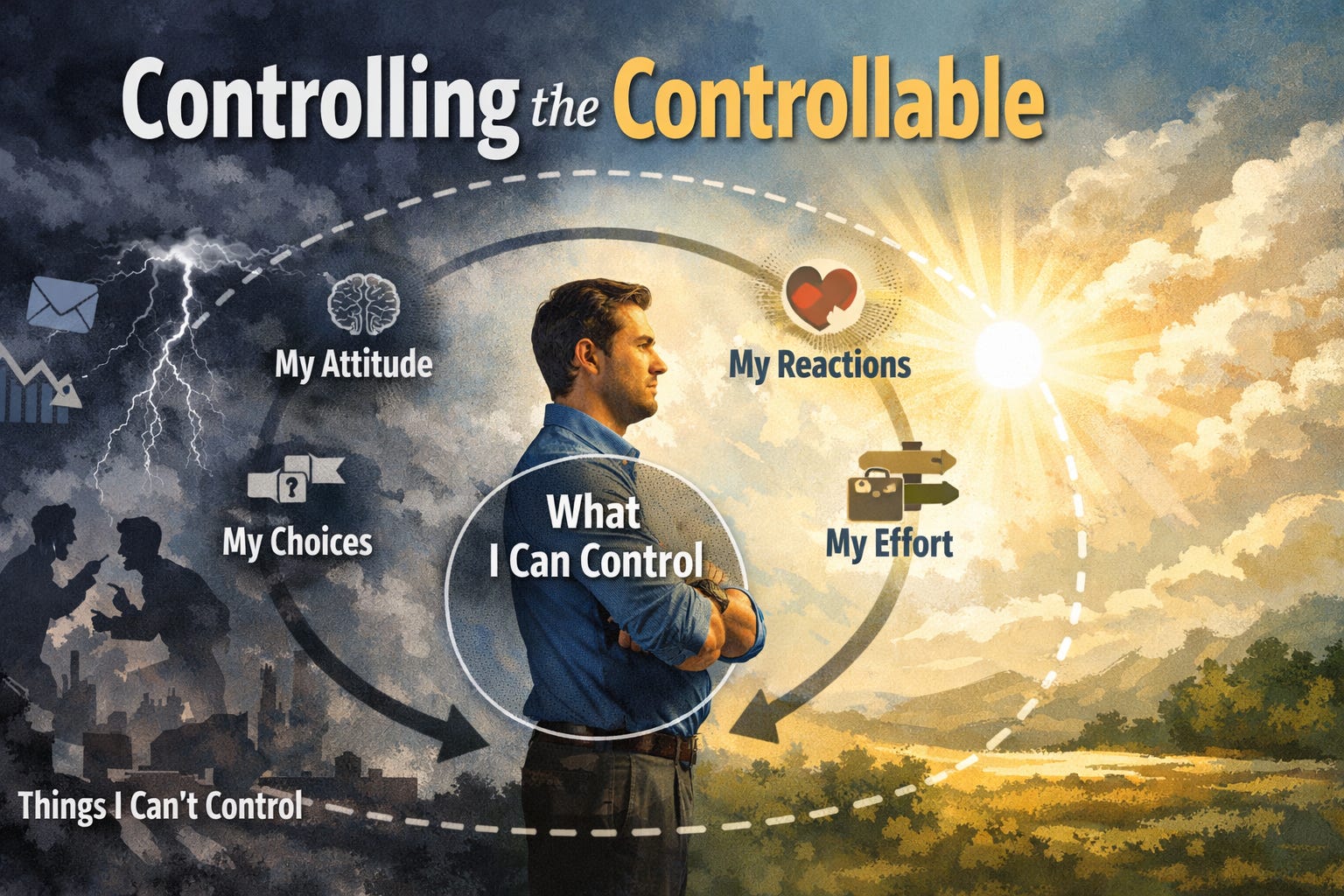
What I can control is me.
That realization did not come instantly. It came after I caught myself spiraling into frustration. It came after I recognized that my mental energy was being spent on areas completely outside my influence.
I was trying to manage other people’s reactions instead of managing my own.
The shift happened when I asked a simple question: What is actually within my control right now?
The list was shorter than my ego wanted it to be.
I could control my response.
I could control my professionalism.
I could control the clarity of my communication.
I could control how I led my team through the transition.
I could control whether I chose bitterness or growth.
That was it.
When you narrow your focus to what is truly controllable, something interesting happens. The emotional temperature drops. The blame softens. The energy shifts from defense to responsibility.
Controlling the controllable is not passive. It is not weakness. It is disciplined leadership.
It requires the humility to admit that you are not in charge of everything. It requires the maturity to recognize where your influence ends. It requires the self awareness to catch your own ego before it drives behavior you later regret.
In this situation, the real work was not fixing the other organization. It was checking my own heart. Was I acting out of pride? Was I trying to win? Was I trying to protect my reputation? Or was I trying to lead well?
When we focus on what we cannot control, we become reactive. We tighten up. We defend. We escalate.
When we focus on what we can control, we become grounded. We respond. We stabilize. We grow.
The loss of a customer is never ideal. A messy transition is even less so. But the lesson was valuable.
Every difficult moment presents two options. We can attempt to control the uncontrollable and fuel frustration. Or we can control ourselves and fuel growth.
The world is full of variables outside our authority. Other people’s opinions. Market conditions. Competitors’ strategies. Clients’ choices. Tone in an email. A comment in a meeting.
If your peace, leadership, or effectiveness depends on controlling those things, you will live in constant agitation.
If instead you anchor yourself to what is yours to manage, your attitude, your words, your effort, your character, you gain something far more powerful than control over others.
You gain control over yourself.
And that is where real leadership begins.