


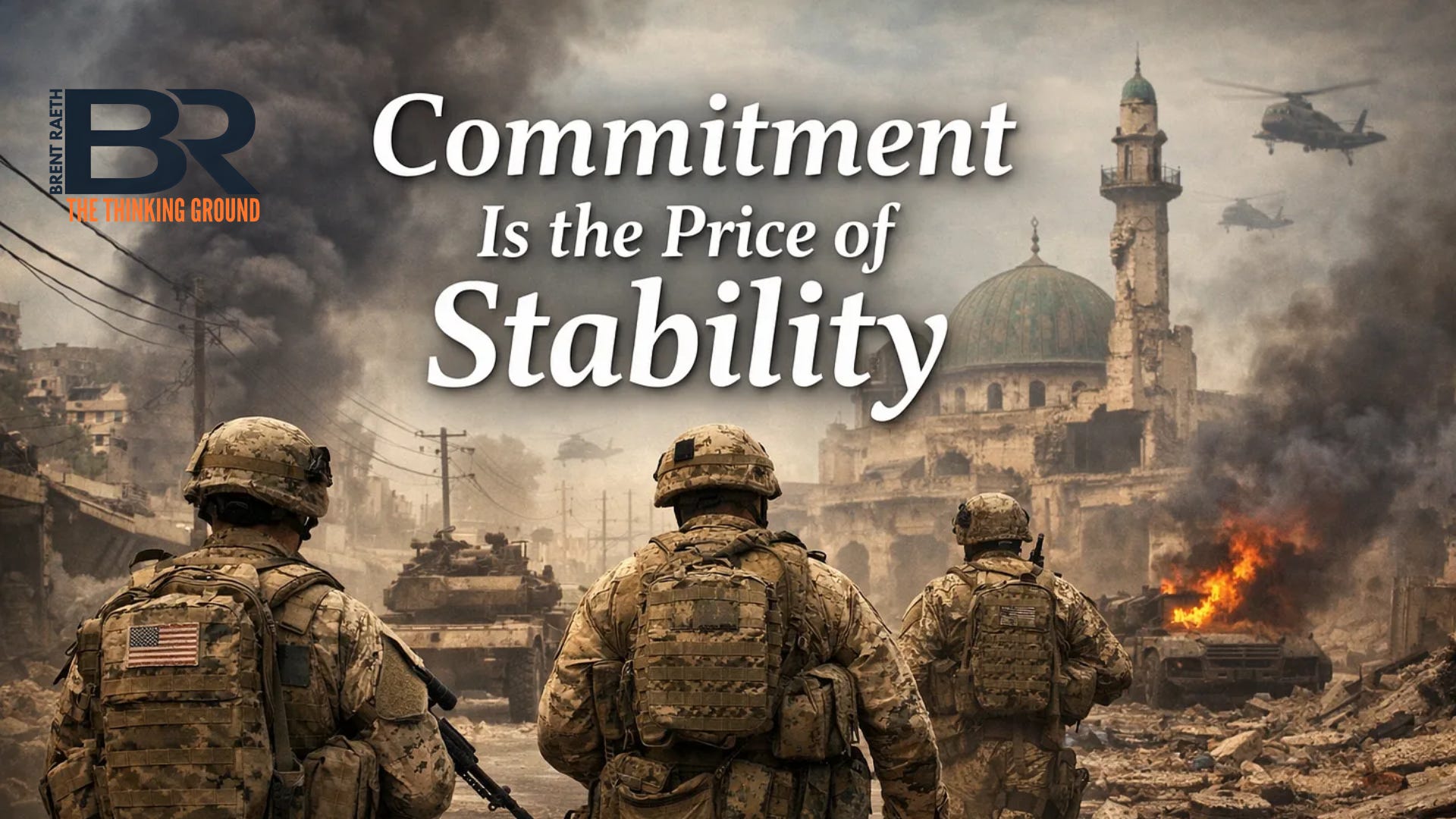
During my time deployed to Iraq, one lesson became unmistakably clear. Stability cannot be declared from afar. It cannot be created through a speech, a policy announcement, or even a series of military strikes. Stability is created through presence and commitment.
I remember traveling through neighborhoods where the atmosphere could shift block by block. On one street, life looked almost normal. A shop owner swept dust from the front of his store. Kids kicked a soccer ball through the street. Men stood together drinking tea and debating politics. Around the corner, however, everything changed. Doors were shut. Windows were dark. The streets were empty.
You could feel the absence of security.
Where people believed someone was firmly in control and capable of maintaining order, they lived their lives openly. They worked, argued about politics, and discussed the future. Where they believed violence could return at any moment, they kept their heads down and stayed silent. That experience revealed something fundamental about both human nature and governance: people do not participate in systems they do not believe will survive.
That lesson is highly relevant as the world watches the escalating conflict involving Iran.
Supporting Action Does Not Mean Pretending It Is Easy
Supporting military action against Iran does not mean pretending the situation is simple. The Iranian regime has spent decades funding proxy forces, destabilizing neighboring countries, pursuing nuclear capabilities, and openly threatening the United States and its allies. Ignoring those realities was never a viable long term strategy. At some point, confronting the problem becomes unavoidable.
However, supporting action also requires acknowledging what meaningful action actually entails. Military strikes are the most visible component of conflict. They are decisive, technologically impressive, and politically easy to communicate. Precision weapons, strategic targets, and dramatic imagery make them appear like a complete solution.
But strikes alone do not create stability.
Air power can degrade infrastructure, disrupt command structures, and weaken an adversary’s immediate capabilities. What it cannot do is establish the conditions necessary for a society to function differently afterward. Stability requires more than disruption. It requires sustained commitment.
The Danger of Half-Fought Wars
One of the most dangerous tendencies in modern Western politics is the desire to achieve the outcomes of war without accepting the commitments required to achieve them. Policymakers often pursue limited actions while hoping they will produce lasting strategic results. History repeatedly shows that this approach rarely succeeds.
When a hostile regime’s power structure is weakened or removed, a vacuum inevitably forms. Vacuums are not filled by idealistic reformers or moderate voices. They are filled by whoever is the most organized, the most heavily armed, and the most willing to use violence. Without a stabilizing force present during that transition, instability is almost guaranteed.
If the objective of action against Iran is simply to weaken the regime temporarily, then limited strikes may accomplish that. If the objective is to permanently alter the security dynamics of the region, however, the requirements become far more substantial.
That reality leads to a difficult but necessary conclusion. Lasting stability often requires boots on the ground.
Security Before Democracy
This is not a politically comfortable statement, but it is a historically consistent one. Democratic systems, civic institutions, and economic development cannot take root in environments where people fear for their safety. Individuals will not vote, organize, build businesses, or publicly engage in governance if they believe doing so might get them killed the following day.
Security comes first.
Only when people believe tomorrow will resemble today do they begin investing in the future. Only then do they risk participating in systems that rely on public engagement and accountability.
That type of security cannot be delivered solely through air campaigns conducted from thousands of miles away.
The Reality We Must Acknowledge
Acknowledging this reality does not mean advocating recklessly for large scale military occupation. Ground commitments carry real costs, real risks, and significant political consequences. Americans are understandably cautious about entering long term conflicts after the experiences of the past two decades.
However, avoiding difficult conversations does not eliminate difficult realities. The United States has chosen to confront Iran militarily, the critical question must be addressed honestly: what does success actually require?
If success means short term disruption, then limited action may be sufficient. If success means creating a stable security environment that prevents future threats and allows different political structures to emerge, history suggests that commitment must extend far beyond initial strikes.
There is no reliable version of this scenario where a country can be destabilized from the air and then naturally reorganize itself into a stable and cooperative regional partner. Hoping for that outcome is not strategy. It is wishful thinking.
Finishing What We Start
The United States now faces a familiar strategic crossroads. One path involves symbolic action and limited engagement followed by a gradual disengagement that assumes the problem will eventually resolve itself. The other path requires accepting that if a hostile regime is confronted directly, the commitment necessary to stabilize the aftermath must also be considered.
Finishing the job does not necessarily mean permanent occupation. It does mean creating enough security and stability that whatever follows has a realistic opportunity to succeed.
My experience in Iraq reinforced a simple but powerful truth.
Stability cannot be built from a distance.
If stability is the objective, commitment is not optional.