


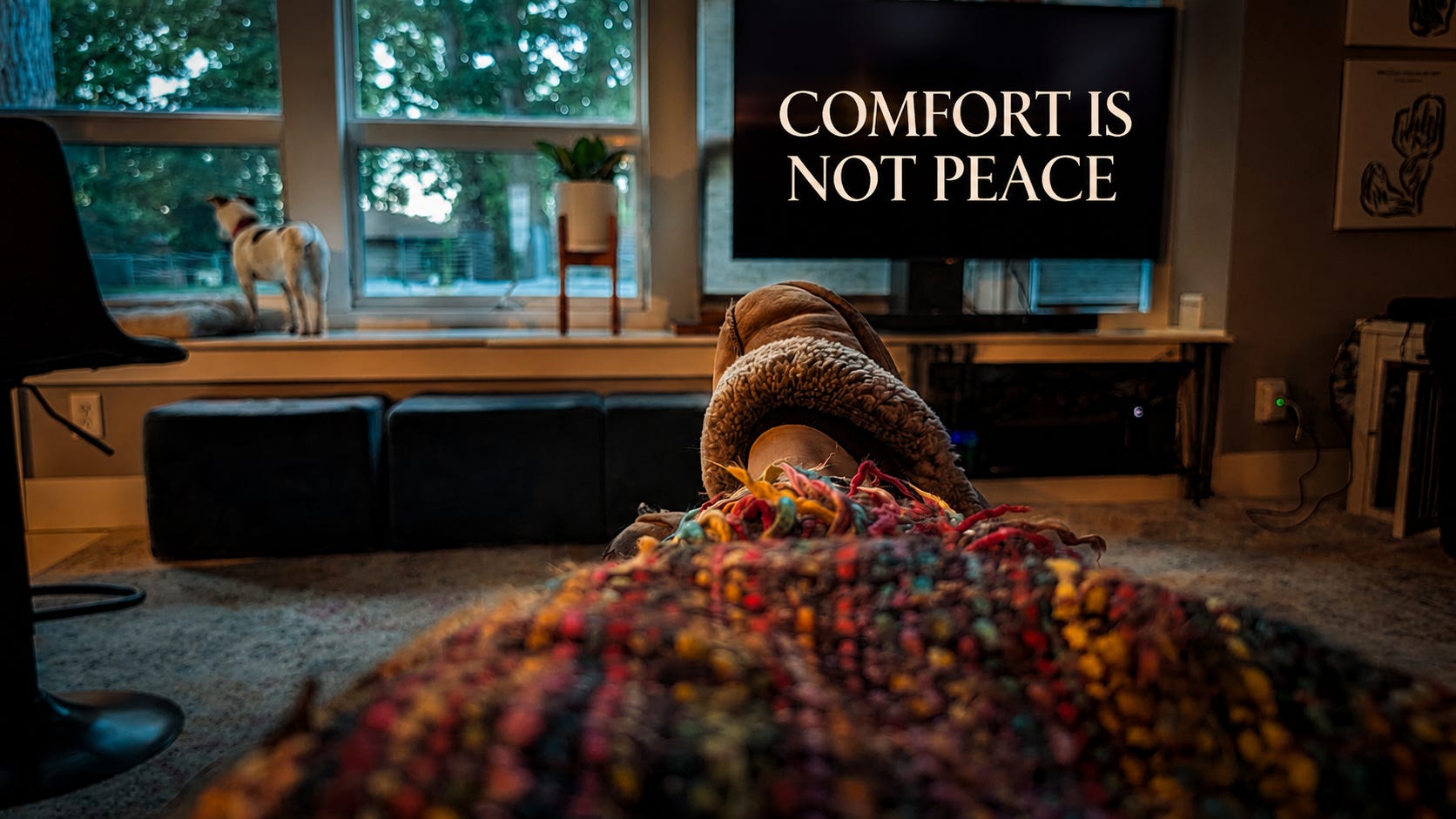
We have become so accustomed to comfort that ordinary discipline can begin to feel like suffering.
Getting out of bed feels unfair. Waiting feels unbearable. Boredom feels like a problem that must be solved immediately. Responsibility feels unusually heavy. Any task we do not want to do becomes evidence that we need more rest, more motivation, or better circumstances.
Rest is not the problem. Comfort is not the enemy. Both are necessary parts of a healthy life.
The danger begins when comfort stops restoring us and starts ruling us.
The Weight Did Not Change
Comfort rarely weakens us all at once. It lowers the amount of difficulty required to overwhelm us.
The alarm clock becomes suffering. A hard conversation becomes suffering. Going without what we want becomes suffering. Being asked to wait, sacrifice, focus, or follow through begins to feel unreasonable.
The weight did not necessarily get heavier. Our capacity to carry it became smaller.
That is difficult to admit because weakness rarely introduces itself as weakness. It sounds much more reasonable than that.
I deserve a break.
I am not in the right mood.
This should not be this difficult.
I will do it when I feel more motivated.
Any one of those thoughts may be true on a particular day. But when they become our default response to effort, they slowly train us to avoid the very things that would make us stronger.
Every difficulty we avoid makes avoidance easier the next time. Every impulse we surrender to becomes more persuasive. Every responsibility we postpone teaches us that our feelings should have the final vote.
Eventually, we do not simply enjoy comfort. We require it.
Peace Survives the Disturbance
Comfort and peace can look similar when life is going well, but they are not the same.
Comfort says, “I am okay because nothing is disturbing me.”
Peace says, “Even when something disturbs me, I can remain steady.”
Comfort depends on our surroundings. Peace depends on what we have built within ourselves.
One survives only while conditions cooperate. The other survives contact with real life.
This distinction matters because life will not always cooperate. People will disappoint us. Plans will fail. Work will become demanding. Our bodies will age. We will face inconvenience, uncertainty, loss, and responsibilities we did not choose.
If our stability depends on avoiding those things, then our peace is fragile. It can be taken from us by a delayed flight, a difficult customer, a critical comment, a financial setback, or a rainy Saturday.
That is not peace. It is favorable circumstances.
What Can You No Longer Go Without?
The Stoics sometimes practiced voluntary discomfort. They ate simple food, wore rough clothing, or temporarily went without conveniences they could afford.
They were not trying to prove that misery was virtuous. They were testing their dependencies.
They wanted to know how much fortune could remove before it also removed their character.
That remains a useful question.
What can you no longer willingly go without?
If you cannot tolerate boredom, you must always be entertained. If you cannot tolerate disagreement, everyone must affirm you. If you cannot tolerate inconvenience, other people must continually arrange life around you. If you cannot tolerate difficulty, you must organize your life around avoiding anything hard.
At that point, the comfort no longer serves you. You serve it.
Anything we cannot willingly put down has acquired authority over us.
Discipline Is Not Punishment
Discipline is often treated as a tool for achievement: a way to become more productive, successful, fit, or wealthy. But its deeper purpose is freedom.
Discipline allows us to act according to our values even when our feelings would prefer something easier.
It asks a better question than, “Do I feel like doing this?”
It asks, “Is this mine to do?”
That question changes everything.
If the conversation is ours to have, we have it. If the commitment is ours to honor, we honor it. If the problem is ours to solve, we begin solving it. If someone is counting on us, we show up.
We stop waiting for the emotional conditions to be perfect. We stop giving every passing mood the authority to renegotiate our principles.
This is especially important in leadership. Leadership rarely happens under ideal conditions. It happens when the decision is difficult, the information is incomplete, the conversation is uncomfortable, and the outcome is uncertain.
A leader who requires comfort before acting will eventually avoid the work leadership requires.
Capacity Can Be Rebuilt
The hopeful truth is that our threshold for discomfort can move in both directions.
What comfort weakened, practice can rebuild.
We rebuild it when we get up when we said we would. When we finish the work before reaching for distraction. When we have the conversation we have been avoiding. When we exercise despite not feeling motivated. When we choose patience over immediate gratification. When we allow ourselves to be bored without instantly reaching for a screen.
These actions may seem small, but they are votes for the kind of person we are becoming.
Over time, what once felt unbearable becomes ordinary. The impulse that once controlled us becomes only a suggestion. The inconvenience that once ruined our day becomes something we simply handle.
We become harder to disturb. This is not because life becomes easier, but because we become more capable.
The goal is not to reject comfort or manufacture misery. It is to become the kind of person who can enjoy comfort without depending on it.
There is nothing wrong with a soft chair, a warm house, an easy day, or a well deserved rest. The question is whether we can remain ourselves when those things are unavailable.
Peace is not the absence of difficulty.
It is the confidence that difficulty does not get to decide who we are.