


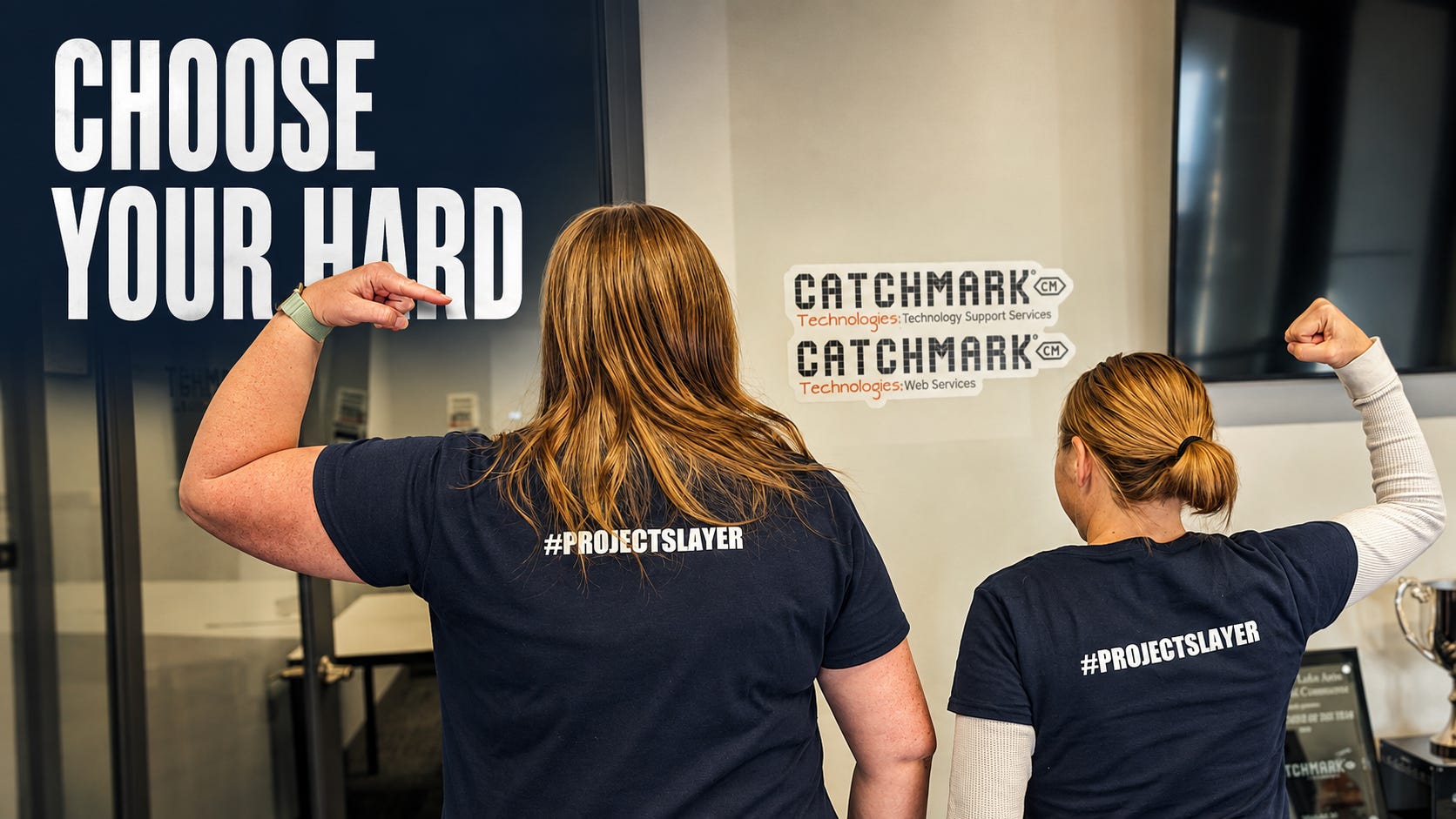
Recently, several of our employees have faced significant decisions about their futures.
Those decisions have led to some frank and direct conversations about the outcomes they are trying to achieve in their lives, their work, and their relationships. We have talked about what they want, what they are willing to sacrifice, and what their choices are likely to produce.
More importantly, we have talked about identity.
Who do they believe they are as a person?
Who do they want to become?
Are their daily choices moving them toward that person, or are they simply protecting them from temporary discomfort?
During one of those conversations, my brilliant wife, Kara, made a simple observation.
“It is going to be hard. It is really about which hard you want to choose.”
That stuck with me.
I have thought about it repeatedly over the past few days, and it encouraged me to put some thoughts on digital paper.
Because she is right.
Most meaningful decisions are not choices between hard and easy. They are choices between one kind of hard and another.
It is hard to exercise consistently, eat with discipline, and care for your health. It is also hard to live with poor health, low energy, and limitations that might have been prevented.
It is hard to live within your means, delay gratification, and say no to things you want. It is also hard to carry debt, fear the next bill, and feel trapped by decisions you made years ago.
It is hard to have an honest conversation with a teammate who is not meeting expectations. It is also hard to watch resentment spread, standards decline, and dependable people become exhausted because nobody was willing to address the problem.
It is hard to admit you were wrong. It is also hard to defend a mistake long after you know the truth.
It is hard to leave a situation that is no longer healthy. It is also hard to remain somewhere that slowly destroys your confidence, character, or peace.
We do not get to choose whether life will be hard.
We get to choose which hard we are willing to carry.
Comfort Is Often Delayed Difficulty
One of the most persistent lies we tell ourselves is that somewhere, just beyond the decision we do not want to make, there is an easy path.
There usually is not.
There is only a different kind of hard.
Avoiding the conversation feels easier than having it.
Skipping the workout feels easier than doing it.
Spending the money feels easier than saving it.
Making the excuse feels easier than accepting responsibility.
Allowing a small problem to continue feels easier than confronting it.
But the difficulty does not disappear. It waits.
Then it returns with interest.
The avoided conversation becomes a conflict. The missed workouts become poor health. The careless spending becomes financial stress. The excuse becomes a pattern. The small problem becomes part of the culture.
What we call comfort is often nothing more than delayed difficulty.
Discipline willingly accepts a smaller difficulty today to avoid a larger one tomorrow.
It chooses the pain of preparation over the pain of regret.
It chooses the discomfort of truth over the slow damage caused by avoidance.
It chooses responsibility while responsibility is still manageable.
Every Choice Sends a Bill
Freedom matters deeply to me.
I believe people should have the freedom to choose how they live, what they pursue, and what they do with their time, ability, and resources.
But freedom does not eliminate consequences.
Every choice sends a bill.
Sometimes the bill arrives immediately. Sometimes it arrives years later. Sometimes we pay it ourselves. Sometimes the people around us pay part of it.
You are free to avoid accountability, but your team will pay for the confusion.
You are free to neglect a relationship, but distance will eventually collect what neglect owes.
You are free to stop learning, but the world will continue changing without you.
You are free to blame other people, but blame will keep you powerless.
That last one matters.
Blame can feel comforting because it removes responsibility from us. It explains why something is difficult without requiring us to change. Sometimes the blame is even accurate. Someone else may truly have failed us. The circumstances may genuinely be unfair.
But being correct about who caused the problem does not solve it.
At some point, we still have to decide what we are going to do next.
That is our hard to choose.
The Hard You Choose Shapes Who You Become
This is why those recent conversations were not only about jobs, opportunities, or immediate outcomes.
They were about who each person is becoming.
Every difficult choice develops something in us.
The hard of discipline builds strength.
The hard of honesty builds trust.
The hard of accountability builds maturity.
The hard of patience builds endurance.
The hard of learning builds competence.
The hard of forgiveness protects us from becoming bitter.
The hard of service keeps us from becoming consumed with ourselves.
Other forms of hard shape us too.
The hard of resentment makes us cynical.
The hard of avoidance makes us fearful.
The hard of constant excuse making makes us powerless.
The hard of protecting our ego makes us fragile.
The hard of chasing comfort makes us less capable of handling discomfort when it inevitably arrives.
That is why the question is not simply, “Which choice hurts less?”
The better question is, “Who will this choice require me to become?”
Some difficulty strengthens your character. Some slowly erodes it.
Some difficulty moves you toward a life you respect. Some keeps you stuck in a life you complain about.
Some difficulty is an investment. Some is merely the recurring cost of avoidance.
Choose carefully.
Leadership Is a Choice Between Difficulties
Leadership is filled with decisions where every option carries a cost.
Holding high standards is hard. Watching standards collapse is harder.
Giving clear feedback is hard. Allowing someone to believe they are succeeding while quietly losing confidence in them is harder.
Removing a person who no longer fits the team is hard. Asking everyone else to compensate for that person indefinitely is harder.
Trusting people with responsibility is hard because they may make mistakes. Refusing to trust them is harder because they will never grow.
Changing direction is hard because people may question your original judgment. Continuing down the wrong path to protect your ego is harder because the organization pays for your pride.
Leaders get into trouble when they choose the hard that protects them personally while pushing the greater hardship onto everyone else.
They avoid the difficult conversation, so the team carries the dysfunction.
They refuse to make a decision, so everyone else lives in uncertainty.
They protect an underperformer from discomfort, so dependable teammates carry more weight.
They protect their image, so the organization loses trust.
Good leadership is not the avoidance of pain. It is the willingness to accept the right pain, at the right time, for the right reason.
Not All Hardship Is Chosen
The phrase “choose your hard” can sound shallow if we are not careful.
Not every struggle is the result of a bad decision.
People get sick. Businesses fail despite tremendous effort. Relationships are damaged by the actions of someone else. Families experience loss. Good people face injustice. Responsible people encounter circumstances they never asked for and could not have prevented.
We should never use personal responsibility as an excuse to withhold compassion.
Sometimes life chooses the hard for us.
But even then, there are often choices left.
We may not choose the loss, but we choose whether grief eventually deepens our compassion or hardens our heart.
We may not choose the setback, but we choose whether we learn from it or allow it to define us.
We may not choose what someone did to us, but we choose how much authority that person will continue to hold over our future.
We may not control the circumstances, but we can still decide whether our response will be rooted in courage, bitterness, honesty, denial, faith, fear, responsibility, or blame.
That does not make the hardship fair.
It makes our response ours.
Choose a Hard Worth Carrying
The goal is not to seek suffering for its own sake.
There is nothing noble about making life unnecessarily difficult. Some people stay in broken systems, tolerate mistreatment, or carry responsibilities that do not belong to them because they believe endurance alone is a virtue.
It is not.
The point is to choose difficulty with purpose.
Choose the hard that builds something.
Choose the hard that protects what matters.
Choose the hard that tells the truth.
Choose the hard that makes you more capable, more trustworthy, and more free.
Choose the hard that your future self will be grateful you accepted.
This applies to our health, finances, marriages, parenting, work, leadership, and communities.
A strong marriage is hard. A broken one is hard too.
Parenting with consistency is hard. Trying to repair years without boundaries is hard too.
Building a healthy organization is hard. Working every day inside a dysfunctional one is hard too.
Participating in your community is hard. Living in a community where everyone complains and nobody contributes is hard too.
Growth is hard. Stagnation is hard too.
The difference is that one kind of hard moves us somewhere.
The Decision in Front of You
Most of us already know where we are choosing the wrong hard.
It is the conversation we keep postponing.
The habit we keep defending.
The boundary we refuse to establish.
The responsibility we keep blaming on someone else.
The decision we hope time will make for us.
We tell ourselves we are avoiding pain, but we are usually choosing a slower version of it.
The right choice may create discomfort today. It may require courage, humility, sacrifice, or change. It may disappoint someone. It may force us to admit that what we have been doing is not working.
But difficulty is not evidence that a decision is wrong.
Sometimes difficulty is the price of finally doing what is right.
Life will be hard either way.
Choose the hard that produces health instead of regret.
Choose the hard that creates trust instead of resentment.
Choose the hard that builds freedom instead of dependence.
Choose the hard that moves you forward instead of keeping you comfortable.
You do not get to avoid every burden.
But you do get a say in which burden you carry, what that burden produces, and who it requires you to become.
Choose your hard.