


Last month I found myself sitting at a conference table between a twenty eight year old marketing manager and a sixty eight year old board member.
The marketing manager wanted immediate change. New branding. New messaging. A stronger social media presence. “If we are not relevant online, we are irrelevant,” she said. “We need to think about how this reflects on us.”
The board member pushed back. “We have done it this way for thirty years,” he replied. “This organization was built on relationships, not trends. People need to respect the legacy.”
Both were articulate. Both were confident. Both were, in their own ways, right.
And both were completely focused on themselves.
As a Gen Xer, I sat there doing what many of us have done our entire lives. Translating. Mediating. Absorbing. Trying to move the conversation forward while quietly wondering how we ended up parenting up and mentoring down at the same time.
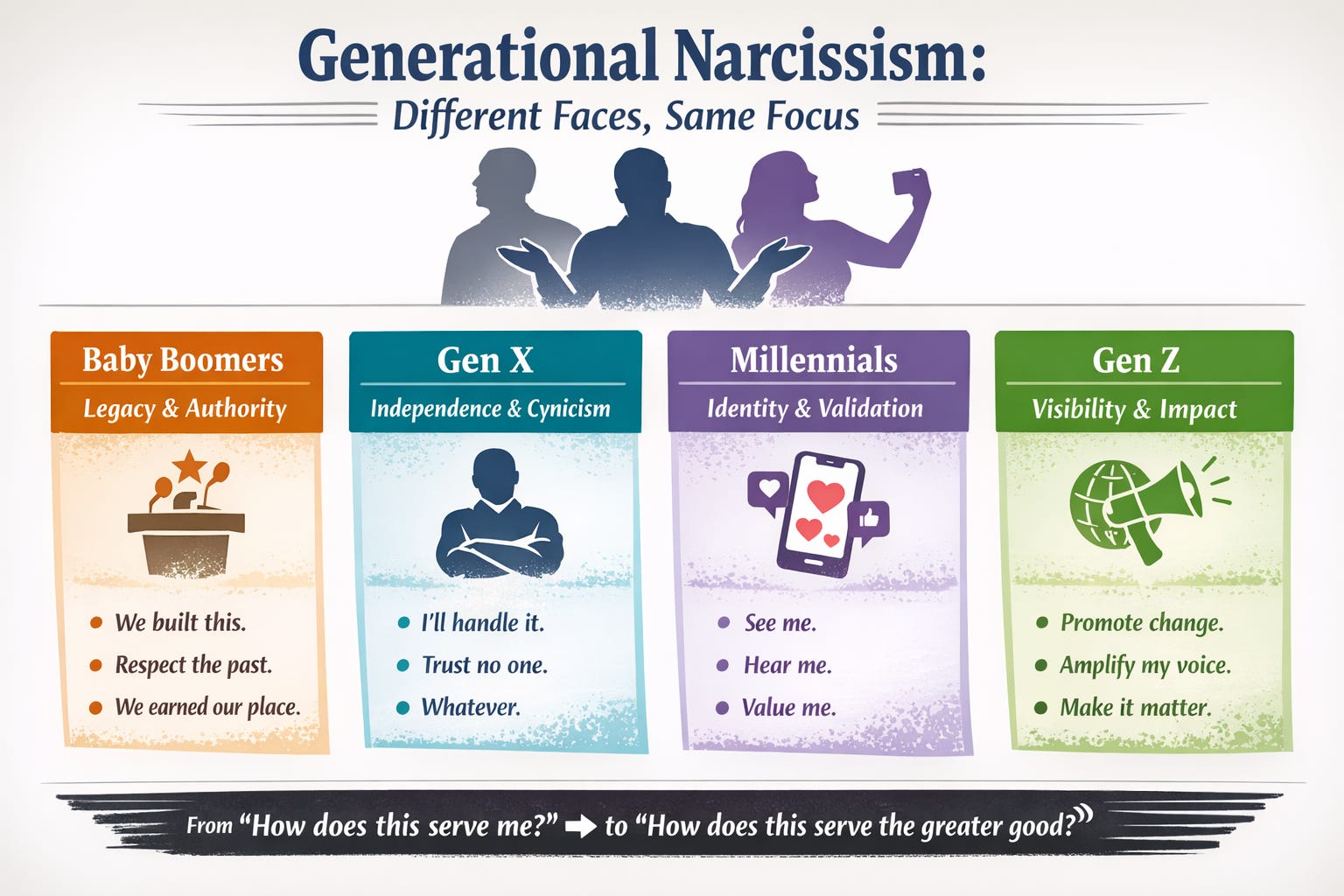
It struck me that what I was witnessing was not just a strategy debate. It was generational narcissism on display. And it presents differently in each cohort.
Baby Boomers often express it through legacy and authority. Their narrative is, “We built this. We sacrificed. We earned the right to lead.” The self focus shows up as an attachment to status, titles, and tradition. Change can feel like disrespect. Critique can feel like erasure. Their identity is often tightly tied to what they built.
Millennials, and even more so Gen Z, tend to express narcissism through identity and visibility. Their narrative is, “See me. Hear me. Validate me.” The self focus shows up in personal branding, constant feedback loops, and a desire for work to align perfectly with personal values and meaning. Institutions exist, in part, to serve their development and expression.
Gen X, my generation, is not immune. Ours is subtler. We pride ourselves on independence. We learned early not to expect too much from institutions or even from authority figures. Our narcissism shows up as self reliance bordering on emotional detachment. “I will just handle it myself.” We sometimes wear cynicism like a badge of honor. We tell ourselves we are above the noise, but we can quietly resent having to clean up everyone else’s mess.
Each generation believes its perspective is the corrective to the excesses of the one before it. Boomers think younger generations are entitled and untested. Millennials and Gen Z think Boomers are rigid and self absorbed. Gen X thinks everyone needs to calm down and get to work.
The friction comes from this simple truth. When every generation centers itself as the main character of the story, collaboration becomes competition.
In the workplace, this looks like endless debates about flexibility versus commitment. It looks like arguments about loyalty versus mobility. It shows up in disagreements over whether feedback is a gift or an insult. It appears in the tension between preserving what works and reinventing everything.
At home, it shows up in how we raise kids, care for aging parents, and define success. One generation values stability. Another values fulfillment. Another values autonomy. None of those are wrong. But when they are framed as morally superior rather than simply different, division follows.
Narcissism is not just excessive selfie culture. It is the belief that my experience is the most important lens through which reality should be interpreted.
Every generation is shaped by its context. Boomers were shaped by post war expansion and institutional trust. Millennials by economic instability and digital connectivity. Gen Z by social media immersion and constant comparison. Gen X by latchkey independence and cultural skepticism.
Those contexts matter. They explain behavior. They do not excuse self absorption.
If we are honest, the issue is not that one generation is uniquely narcissistic. It is that our culture rewards narcissism. It monetizes attention. It amplifies outrage. It encourages personal platforms over shared purpose.
As a Gen Xer, caught in the middle more often than I would like, I have learned that translation is more valuable than triumph. Someone has to remind the board member that legacy is strengthened, not weakened, by adaptation. Someone has to remind the marketing manager that not every disagreement is invalidation.
Maybe the path forward is not proving which generation is right. Maybe it is asking a better question.
What if instead of asking, “How does this serve me?” we asked, “How does this serve the mission, the family, the community?”
That shift requires humility. It requires acknowledging that our generational story is not the whole story.
And perhaps that is the real antidote to generational narcissism. Not silencing a generation. Not shaming a cohort. But decentering ourselves just enough to make room for something larger than our own reflection.