


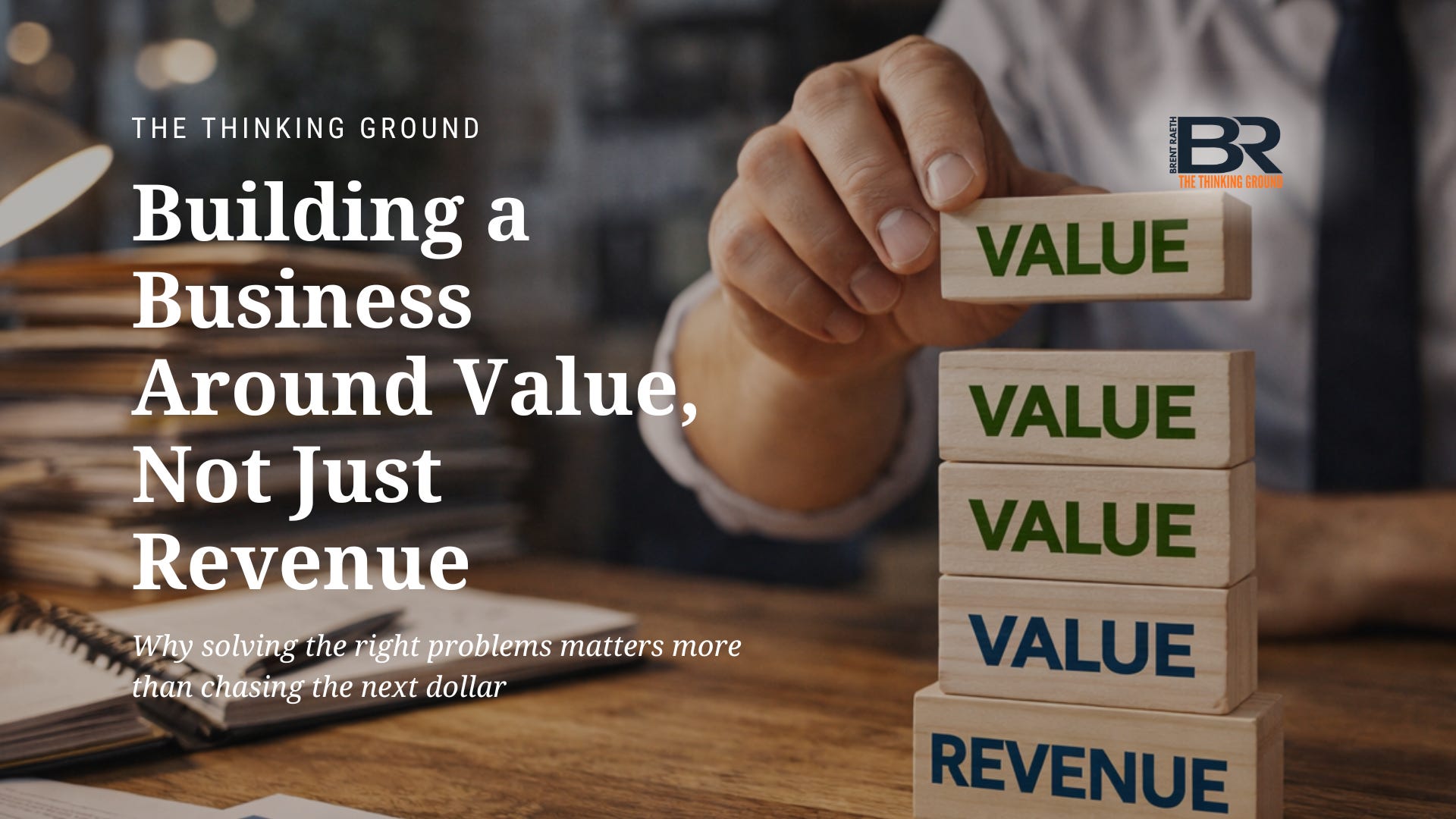
Revenue is one of the most visible metrics in business. It is easy to measure, easy to track, and easy to celebrate. In the early stages of a company, it often becomes the primary signal of progress. If revenue is growing, the assumption is that the business is working.
But revenue, by itself, can be misleading.
Not all revenue is created equal, and not all growth is sustainable. The businesses that endure are not built on revenue alone. They are built on value.
The Difference Between Revenue and Value
Revenue answers a simple question: did someone pay you? Value answers a more important one: did you solve a meaningful problem in a way that lasts?
It is entirely possible to generate revenue without creating lasting value. Short-term projects, one-off transactions, and reactive services can all produce income, especially in the early stages of a business. In fact, they often feel like progress because they bring immediate results.
However, they rarely build momentum.
Value, on the other hand, compounds over time. When you consistently solve real problems in a meaningful and repeatable way, customers stay, relationships deepen, and your reputation strengthens. Growth becomes less volatile and more predictable because it is anchored in something more substantial than transactions.
Understanding that difference is straightforward. Operating with that discipline is where it becomes difficult.
The Pressure to Chase Revenue Early
In the early stages of building a business, the pressure to generate revenue is real and constant. There are expenses to cover, payroll to meet, and a model to validate. In that environment, it is natural to prioritize opportunities that bring in cash, even when they do not align with long-term value creation.
I have experienced this directly at CatchMark.
Early on, we had access to a wide range of opportunities. Some aligned closely with where we wanted to go, while others were more transactional in nature. They solved immediate problems for customers, but they did not contribute to a broader or more strategic relationship.
Those opportunities were difficult to turn down. Revenue is tangible and immediate. Value is often delayed and harder to measure in the moment.
Over time, though, the distinction became clear.
When Revenue Does Not Build the Business
There were projects that generated strong revenue but required heavy customization, constant context switching, and ongoing reactive support. While they kept the team busy, they did not make the business better.
They did not improve our systems, strengthen our positioning, or create repeatable processes that could scale. In some cases, they even pulled us away from investing in the capabilities that would define our future.
That realization forced a shift in thinking.
Not all revenue moves the business forward. Some of it simply maintains activity without creating progress.
Shifting Toward Value at CatchMark
As we matured, we made a deliberate shift at CatchMark. We moved away from primarily project-based, reactive work and toward structured, ongoing services designed to solve deeper and more meaningful problems for our clients.
Managed services and cybersecurity became core areas of focus, not just because they generated revenue, but because they created sustained value.
Instead of asking, “What can we sell?” we began asking, “What problems can we consistently solve?”
That shift changed how we engaged with clients. Rather than responding to issues as they arose, we focused on preventing them. Instead of completing isolated projects, we built long-term partnerships centered on stability, security, and strategic alignment.
The results were significant. Client relationships became longer and more stable, delivery became more consistent, and the team gained clarity in how to execute. Growth did not just continue, it became more predictable and more aligned with our long-term direction.
Revenue still mattered, but it became the result of value creation rather than the driver of every decision.
Value Creates Alignment
When a business is built around value, it creates alignment across the organization. The team understands what matters, decisions become clearer, and tradeoffs are easier to evaluate because there is a shared understanding of success beyond just hitting a number.
It also changes how customers experience the business. They are not simply purchasing a service. They are investing in an outcome. That shift builds trust, and trust becomes one of the most valuable assets a business can develop.
While trust is difficult to quantify, it shows up in retention, referrals, and the willingness of customers to deepen the relationship over time.
The Discipline Required to Build Value
Building around value requires discipline, particularly when short-term opportunities are available. It means being willing to walk away from revenue that does not align, investing in capabilities that may not produce immediate returns, and prioritizing long-term outcomes over short-term gains.
At CatchMark, this showed up in our decision to standardize offerings, invest deeply in cybersecurity expertise, and build systems that supported consistent and repeatable delivery. These were not always the fastest paths to revenue, but they were the right decisions for building a sustainable business.
Over time, those decisions compound. They create efficiency, strengthen reputation, attract the right customers, and position the business for long-term success.
A Better Way to Measure Progress
If revenue is not the only measure of success, then the question becomes what should replace it.
A better approach is to evaluate whether the business is consistently solving meaningful problems, whether services are repeatable and scalable, whether relationships are strengthening over time, and whether each customer interaction improves the overall capability of the organization.
These questions are more complex than tracking revenue, but they provide a clearer and more accurate picture of progress.
The Long-Term Payoff
Building a business around value is not the fastest way to grow, but it is the most reliable. It creates a foundation that can sustain pressure, adapt to change, and improve over time.
It transforms customers into long-term partners, services into scalable solutions, and effort into lasting impact.
Revenue will always matter. But when it becomes the sole focus, it can lead to decisions that weaken the business over time.
Value strengthens it.
And in the long run, the businesses that prioritize value are the ones that not only grow, but endure.