


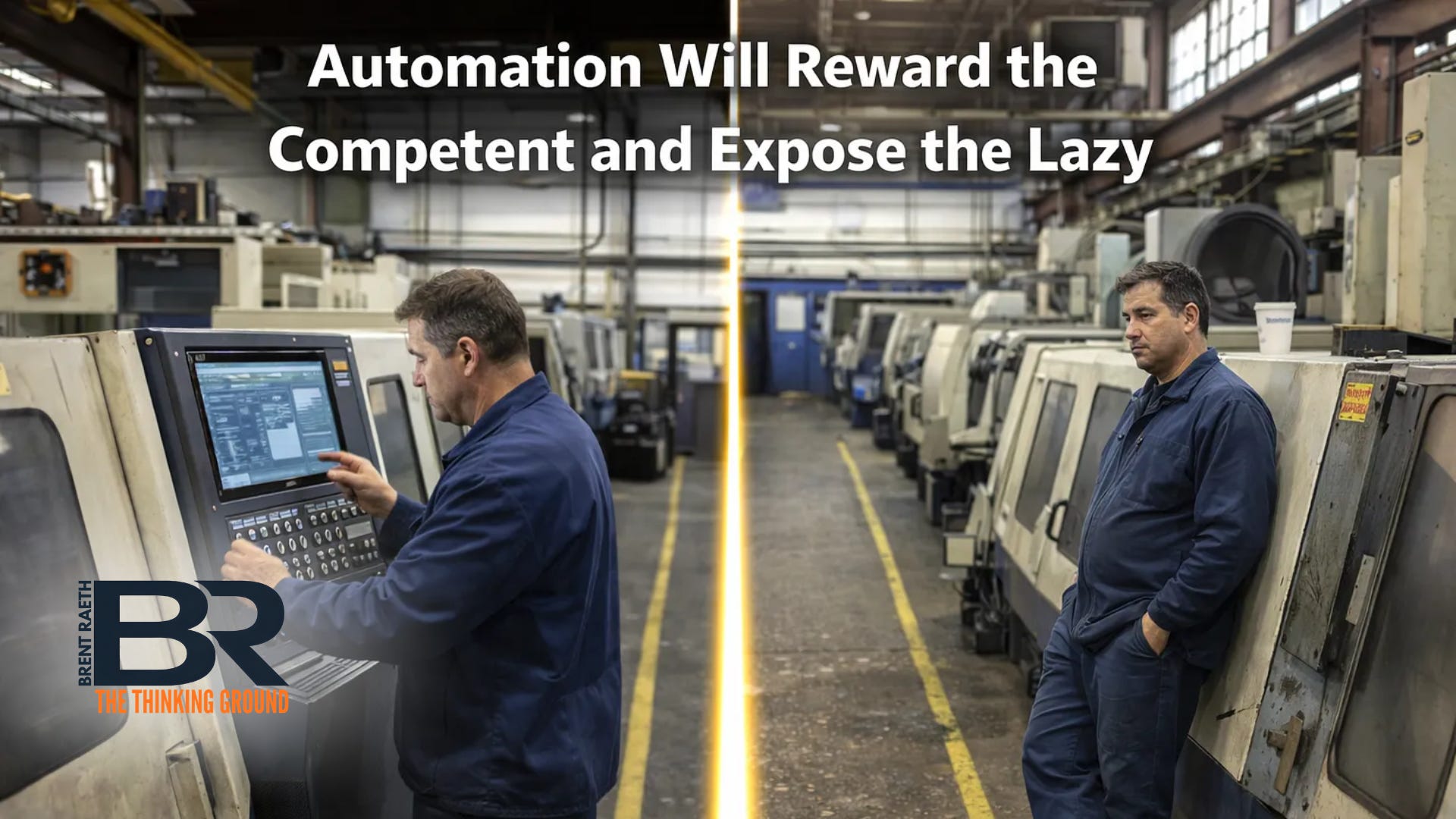
A few years ago, a manufacturing company we provide technology support for installed a new automated production system.
The machines were faster, more precise, and capable of running nearly nonstop. The leadership team explained to the staff that automation was not replacing them. It was changing how the work would be done. The operators would now oversee the systems, troubleshoot problems, and optimize production rather than manually perform every task.
Two very different reactions emerged.
One operator leaned in. He learned how the new machines worked. He studied the control panels. When something malfunctioned, he experimented, asked questions, and tried to understand the underlying process. Within months, he had become the person everyone called when the system acted strangely. Production improved when he was on shift because he understood how to make the system perform at its best.
Another operator did the opposite. He treated the new system as something that simply “ran itself.” When issues occurred, he waited for maintenance. When alerts appeared, he cleared them without investigating. Over time, it became obvious that the machine was not the problem.
The difference was the operator.
Automation had not changed their intelligence or their potential. It simply made the gap in competence visible.
And this pattern is about to repeat itself across nearly every profession.
The Misunderstanding About Automation
Many people still frame automation and artificial intelligence as a threat to jobs. In reality, the more interesting story is what it does to performance.
Automation removes friction. It eliminates routine tasks, repetitive calculations, and mechanical processes that used to consume time and energy. What remains is the thinking.
This changes the nature of work.
When machines handle the routine, the value shifts to the person who understands the system, asks better questions, interprets results, and applies judgment.
In other words, automation magnifies competence.
The Competence Multiplier
A competent person becomes dramatically more effective when paired with automation.
A skilled engineer using AI-assisted design tools can explore dozens of solutions instead of one. A thoughtful marketer can analyze customer data in minutes rather than weeks. A capable cybersecurity professional can use automation to detect patterns and threats that would otherwise go unnoticed.
The technology does not replace their expertise. It amplifies it.
Their ability to think, interpret, and decide becomes the constraint rather than their available time.
Competent people will look superhuman in this environment because the tools multiply their capability.
The Exposure Effect
Automation also removes something else: the ability to hide behind busyness.
For decades, much of work involved performing visible activity rather than producing meaningful outcomes. Meetings, reports, manual processes, and bureaucratic steps created the appearance of productivity even when little value was produced.
Automation strips much of that away.
When systems can generate reports instantly, automate workflows, and handle routine analysis, the remaining contribution must come from the person.
The question becomes simple.
What insight did you add?
What decision did you improve?
What problem did you solve?
For those who are curious, disciplined, and thoughtful, this environment is energizing. For those who relied on activity instead of competence, it becomes uncomfortable very quickly.
The AI Parallel
Artificial intelligence is accelerating this effect.
A curious professional can use AI to research faster, test ideas, write drafts, analyze patterns, and explore solutions. It becomes a thinking partner that expands what one person can accomplish.
But AI also exposes a weakness.
If someone blindly accepts whatever the system produces without understanding it, the results can be embarrassingly wrong. The technology does not remove the need for judgment. It demands it.
The person who asks better questions and critically evaluates the output will thrive. The person who simply presses the button will not.
The same tool produces two completely different outcomes depending on the competence of the user.
The Future of Work
Automation will not eliminate the need for people.
It will eliminate the need for people who contribute very little beyond mechanical effort.
The future workplace will increasingly reward those who demonstrate curiosity, judgment, accountability, and the willingness to learn how systems work. These are the people who will harness automation to create more value than ever before.
At the same time, those who avoid learning, resist responsibility, and rely on routines will find fewer places to hide.
The technology will make that difference visible.
The Real Choice
The question facing every professional today is not whether automation will change their job.
It will.
The real question is how they will respond.
Some will treat new tools as an opportunity to expand their capability. They will study them, experiment with them, and integrate them into their work. Their competence will compound.
Others will treat automation as a shortcut. They will press the button and hope the answer is correct. When it is not, they will blame the technology.
But the technology is not the story.
Automation does not determine outcomes.
It simply reveals who is actually good at what they do.